
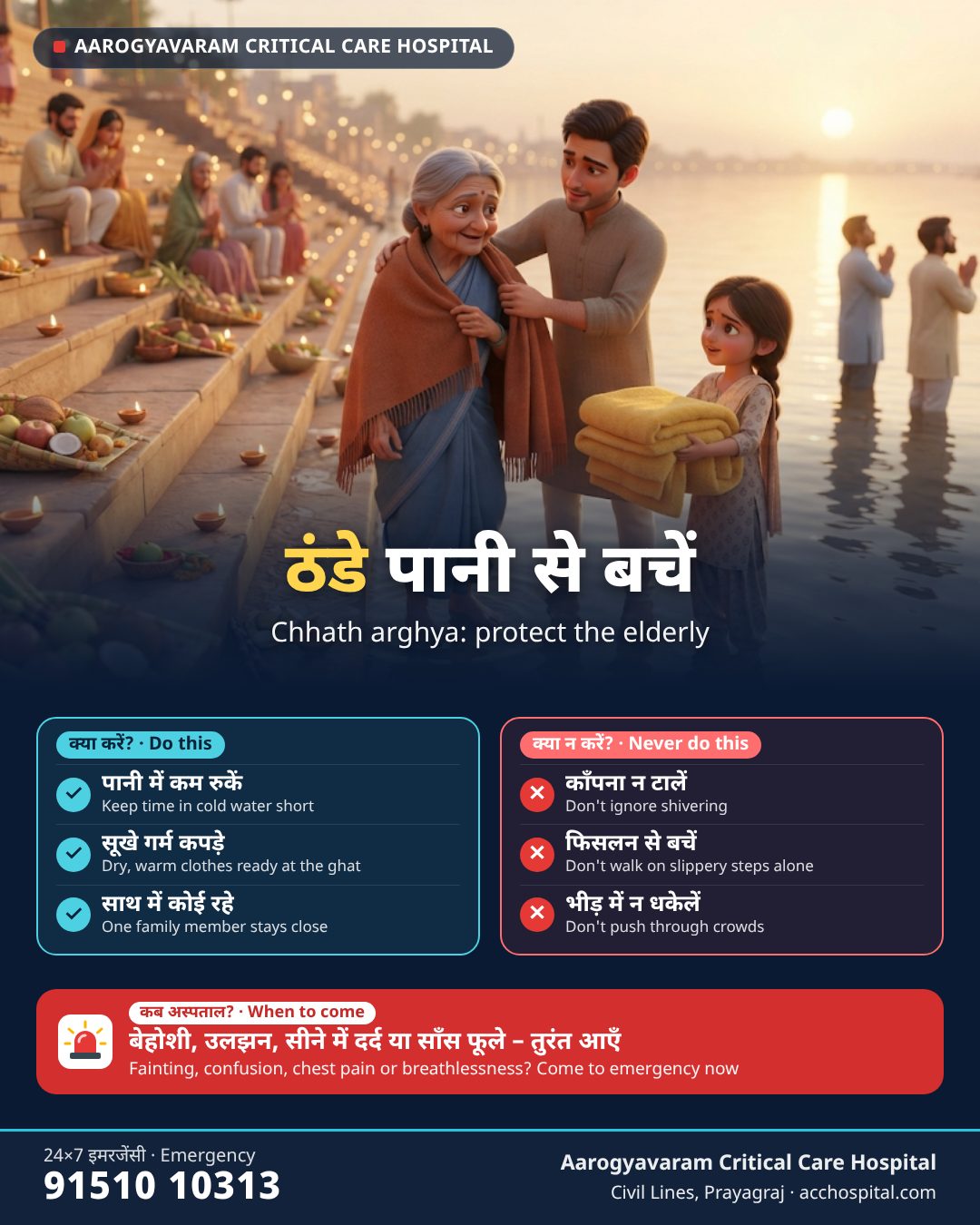
During Chhath, families across Prayagraj gather at the Sangam, the Ganga and Yamuna ghats and local ponds to offer arghya to the setting and rising sun. Devotees often stand waist-deep in water for a long time, in the evening chill and again before sunrise, usually after a long fast. For young, healthy people this is tiring but manageable. For elderly devotees, and for anyone with heart disease, high blood pressure, diabetes or lung disease, cold water, wet clothes, slippery steps and crowds together can cause serious problems. The one thing to remember: keep the time in cold water short, get into dry warm clothes quickly, and never leave an elderly devotee alone at the ghat.
24×7 Emergency 📞 Call 91510 10313
What happens to the body in cold water? (Thande paani mein sharir ka kya hota hai?)
Water draws heat away from the body many times faster than air. When a person stands in cold river water in November, especially with wet clothes in a breeze, the body loses heat quickly. At first the person shivers, which is the body's way of making heat. If the cold continues, body temperature can fall too low. This is called hypothermia (sharir ka taapmaan bahut gir jana).
Cold also tightens the blood vessels in the skin. This raises blood pressure and makes the heart work harder. In a person who already has heart disease or high BP, and who is also tired and dehydrated after a long fast, this extra strain can bring on chest pain, an irregular heartbeat or, rarely, a heart attack. Elderly people feel cold less sharply and make less body heat, so they can become dangerously cold without complaining.
Symptoms and warning signs
Early signs of getting too cold:
- Constant shivering, chattering teeth
- Cold, pale or bluish hands, feet and lips
- Numb fingers, clumsy hands
- Feeling very tired or weak
Signs that the cold is becoming dangerous:
- Shivering that stops while the person is still cold – this is a serious sign, not a sign of getting better
- Confusion, slurred speech or unusual drowsiness
- Slow or shallow breathing
- Stumbling, unable to stand or walk properly
- Fainting
Signs that the heart or circulation is under strain:
- Pain, pressure or tightness in the chest
- Breathlessness
- Dizziness, fast or irregular heartbeat
- Sweating with weakness
Causes and who is at risk
The main causes are long time in cold water, wet clothes afterwards, cold wind at dusk and dawn, and an empty stomach and low fluids after fasting. Those at higher risk include:
- People above 60, and especially above 70
- People with heart disease, high BP, diabetes, kidney disease, asthma or COPD
- People who are thin, frail or recently unwell
- Anyone who has fasted for many hours without water
- Small children brought into the water with the family
Falls are the other big risk. Ghat steps are wet, mossy and often poorly lit before sunrise, and crowds push from all sides. An elderly person who slips can break a hip or wrist, or hit their head.
First aid: what to do at home or at the ghat
- Get the person out of the water at once if they are shivering hard, look pale or say they feel unwell.
- Move them out of the wind to a sheltered place.
- Remove wet clothes gently and dry the skin with a towel.
- Wrap them in dry warm clothes, a shawl or blanket, and cover the head and feet.
- If they are fully awake and can swallow, give warm (not hot) water or a warm, non-alcoholic drink.
- Let them sit or lie down; do not make them walk long distances while very cold or dizzy.
- Stay with them and keep watching their breathing, speech and alertness.
- If they have chest pain, confusion, breathlessness or faint, arrange to reach a hospital emergency straight away.
What not to do: common mistakes and myths
- Do not ignore constant shivering as "just thand" – it is the body's warning.
- Do not rub the hands and feet hard or put them close to a fire or very hot water; cold skin burns easily.
- Do not give alcohol "to warm up" – it actually makes the body lose heat faster.
- Do not give food or drink to someone who is drowsy or confused; they may choke.
- Do not let an elderly person walk alone on wet steps, especially in the dark.
- Do not push through crowds or rush down the steps after the arghya.
- Do not stop regular BP, heart or diabetes medicines on your own because of the festival.
When to go to the emergency
Come to the emergency at once if there is:
- Fainting or collapse
- Confusion, slurred speech or unusual drowsiness
- Shivering that stops while the person is still cold
- Chest pain, pressure or breathlessness
- Fast or irregular heartbeat with dizziness
- A fall with a head injury, vomiting after the fall, or inability to stand or move a leg
- A child who becomes cold, floppy or very sleepy after being in the water
- Anyone who swallowed water and now has a cough, breathlessness or drowsiness
Do not wait to see whether it settles. Heart problems and severe cold need treatment quickly.
How doctors diagnose it
At the hospital, doctors check body temperature, pulse, blood pressure, breathing and oxygen level. They usually do an ECG to look at the heart rhythm and check for heart strain. Blood tests may include sugar, salts (electrolytes) and kidney function, because long fasting and dehydration can change these. If there has been a fall, X-rays or a CT scan of the head may be needed.
Treatment options
Treatment depends on what is found. Mild cold is treated with gentle rewarming, warm blankets and warm fluids. Severe hypothermia needs careful rewarming with close heart monitoring, often in an ICU. Dehydration and low sugar are corrected with fluids through a drip when needed. Chest pain is treated as a possible heart attack until proven otherwise. Fractures and head injuries are managed by the trauma and orthopaedic teams.
Recovery and care at home
Most people who were only mildly cold recover fully within hours once warm and dry. After the festival, elderly family members should rest, eat light warm meals, drink enough fluids and take their regular medicines on time. If dizziness, cough, fever or chest discomfort appears in the next day or two, see a doctor.
Prevention
- Ask the family doctor beforehand how long an elderly or unwell devotee can safely stand in water.
- Keep the time in water as short as the ritual allows; family members can take turns.
- Carry a dry towel, a change of warm clothes, a shawl, socks and a cap to the ghat.
- Choose a less crowded, well-lit spot with firm steps, and reach early.
- Wear footwear with a good grip up to the water's edge.
- One family member stays with every elderly devotee all the time.
- Keep children away from deep water and hold their hands near the edge.
- Take regular medicines as advised by the doctor, and carry them with you.
Ayushman Bharat and cashless treatment
Aarogyavaram Critical Care Hospital is empanelled under Ayushman Bharat (PMJAY), and many private health insurance policies are accepted for cashless admission, as per the rules of the scheme or policy. Please bring your Ayushman card or insurance card and a photo ID when you come.
Frequently asked questions
How long can an elderly person stand in cold water for Chhath arghya?
There is no single safe time; it depends on the person's health and the weather. Keep it as short as the ritual allows, and ask the family doctor beforehand if the person has heart, BP, sugar or lung problems.
Thand se kaanpna kab khatarnaak hai?
Shivering is the body's warning. If shivering stops while the person is still cold, or there is confusion, slurred speech or drowsiness, the body temperature may be dangerously low – come to the emergency.
Ghat par buzurg behosh ho jaye to kya karein?
Lay them down in a safe dry place, check breathing, remove wet clothes and cover them warmly. Do not put anything in the mouth. Reach the nearest emergency at once.
Is cold water bad for heart patients?
Cold makes blood vessels tighten and the heart work harder. Heart patients can still take part, but should take medical advice first, limit time in the water and stop at once if there is chest pain or breathlessness.
Should I give brandy or alcohol to warm someone up?
No. Alcohol makes the body lose heat faster and can hide warning signs. Give warm, non-alcoholic fluids only if the person is fully awake.
Thand lagne ke baad garam paani se nahana theek hai?
Use warm, not hot, water or simply dry clothes and blankets. Very hot water or a fire close to cold skin can cause burns.
Ghat ki seedhi par gir gaye, kab hospital jaana chahiye?
Come at once after any head injury, vomiting, drowsiness, severe pain, or if the person cannot stand or move a leg. In elderly people, a hip fracture can follow even a simple fall.
Can children go into the water for Chhath?
Small children feel cold quickly and can slip into deeper water. Keep them at the edge, hold their hands, and keep their time in water very short.
Aarogyavaram Critical Care Hospital, Prayagraj
Aarogyavaram Critical Care Hospital is on T.B. Sapru Marg, Civil Lines, Prayagraj, with a 24×7 emergency and ICU, and care for cold exposure, heart emergencies and falls. We receive patients from across Prayagraj – Civil Lines, George Town, Katra, Allahpur, Tagore Town, Ashok Nagar, Kareli, Dhoomanganj, Teliyarganj, Rajapur, Mumfordganj, Kydganj, Chowk, Naini, Jhunsi, Phaphamau, Jhalwa, Bamrauli, Subedarganj and Preetam Nagar – and referrals from Kaushambi, Pratapgarh, Bhadohi, Mirzapur, Fatehpur, Chitrakoot, Banda, Jaunpur, Sultanpur, Varanasi, Rewa and Satna. 24×7 Emergency: 91510 10313.
This article is general health information, not medical advice. Diagnosis and treatment are decided by the treating doctor after examination. In an emergency, call 91510 10313 or go to the nearest hospital.