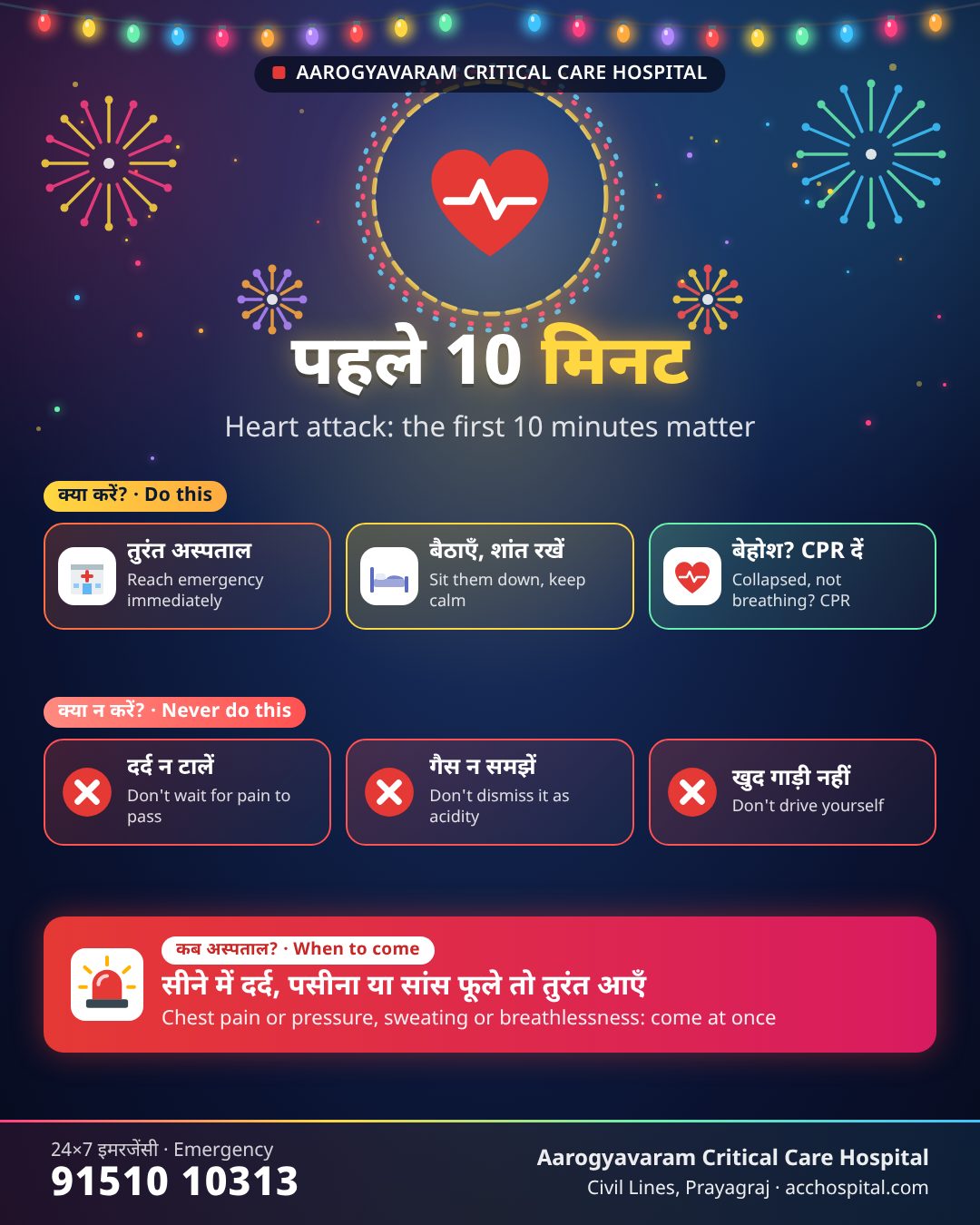
A heart attack happens when blood flow to part of the heart muscle is suddenly blocked. Every minute without blood flow damages more of that muscle, which is why doctors say "time is muscle". In Prayagraj, heart attack cases tend to rise in the winter months, when cold mornings, heavy festive and wedding meals, missed medicines and sudden exertion all put extra strain on the heart. The one thing to remember: if you suspect a heart attack, do not wait for the pain to settle – reach an emergency immediately.
24×7 Emergency 📞 Call 91510 10313
What is a heart attack? (Heart attack kya hai?)
The heart is a muscle that gets its own blood supply through small vessels called coronary arteries. Over years, fatty deposits (plaque) can build up inside these arteries. If a plaque cracks, a blood clot forms on it and can block the artery completely. The part of the heart muscle supplied by that artery starts to die. Doctors call this a myocardial infarction, or MI. In Hindi it is called दिल का दौरा or हार्ट अटैक.
A heart attack is not the same as cardiac arrest. In a heart attack, the person is usually awake and in pain. In cardiac arrest, the heart suddenly stops pumping effectively, the person collapses, becomes unresponsive and stops breathing normally. A heart attack can lead to cardiac arrest, which is why quick action matters so much.
Symptoms and warning signs
Heart attack symptoms are not always dramatic. Watch for:
- Chest pain, pressure, tightness, squeezing or heaviness in the centre or left side of the chest, lasting more than a few minutes or coming and going
- Pain spreading to the left or right arm, shoulder, neck, jaw, back or upper stomach
- Sweating, often cold and heavy
- Breathlessness, with or without chest pain
- Nausea or vomiting, a feeling of "gas" or acidity that does not settle
- Sudden giddiness, weakness, fainting or a feeling that something is very wrong
Women, the elderly and people with diabetes may have mild or unusual symptoms – only breathlessness, tiredness, upper stomach discomfort or sweating – and sometimes almost no chest pain at all. This is called a silent heart attack. In these groups, take any sudden, unexplained symptom seriously.
Causes and who is at risk
Most heart attacks come from coronary artery disease that builds up silently over many years. Your risk is higher if you have:
- High blood pressure (हाई बीपी)
- Diabetes or pre-diabetes (शुगर)
- High cholesterol
- Smoking, bidi, gutkha or tobacco use in any form
- Obesity, especially fat around the waist
- Little physical activity
- A family history of heart disease at a young age
- Long-term stress and poor sleep
- Age above 40 in men and after menopause in women, though heart attacks are now seen in younger people too
Winter adds triggers: blood vessels narrow in the cold, blood pressure rises, people exercise less, and heavy meals and late nights during festivals and weddings add load.
First aid: what to do at home
If you think someone is having a heart attack:
- Stop all activity. Make the person sit down and rest in a comfortable half-sitting position. Do not let them walk around.
- Arrange to reach the nearest emergency immediately. Call the hospital or an ambulance on the way so the team can be ready.
- Loosen tight clothing around the neck, chest and waist. Keep them warm and calm.
- Do not leave the person alone. Note the time the symptoms started – doctors will ask.
- Carry their medicine list, old prescriptions, ECG reports and any hospital file with you.
- Medicines: do not give any tablet unless a doctor advises it for that person. Some people have standing advice from their own doctor for chest pain – follow only that.
- If the person collapses, does not respond and is not breathing normally, start hands-only CPR: place the heel of one hand in the centre of the chest, the other hand on top, and push hard and fast (about 100 to 120 times a minute, about 5 cm deep) without stopping until help arrives or the person starts breathing.
What not to do: common mistakes and myths
- Do not wait to "see if it settles". Many people lose precious hours this way.
- Do not dismiss chest discomfort as gas or acidity, especially in someone with BP, diabetes or a smoking habit. Let a doctor decide.
- Do not let the patient drive themselves or climb stairs.
- Do not give home remedies, oils, massage, or water forcefully to an unconscious person.
- Do not take medicines on your own or from a chemist without a doctor's advice.
- Myth: "Heart attacks only happen to old people." They are seen in people in their 30s and 40s too.
- Myth: "If the ECG is normal, it is not a heart attack." An early ECG can be normal; doctors may repeat it and do blood tests.
- Myth: "No chest pain means no heart attack." Diabetics and the elderly may have silent attacks.
When to go to the emergency
Go to the emergency at once – do not wait – if there is:
- Chest pain, pressure or heaviness lasting more than a few minutes
- Chest pain with sweating, breathlessness, vomiting or giddiness
- Pain spreading to the arm, jaw, neck or back
- Sudden breathlessness, especially lying flat
- Fainting, sudden weakness or confusion
- Any collapse – start CPR and get help
How doctors diagnose it
In the emergency, doctors first check pulse, blood pressure and oxygen and attach a heart monitor. An ECG (heart tracing) is done within minutes. Blood tests for heart muscle damage (such as troponin) are sent, and may be repeated after a few hours. An echocardiogram (ultrasound of the heart) shows how well the heart is pumping. If needed, a coronary angiography is done in a cath lab to see exactly which artery is blocked.
Treatment options
Treatment depends on the type of heart attack, how long ago it started and the patient's overall condition. Doctors may use medicines to thin the blood and protect the heart, clot-dissolving treatment in some situations, and procedures to open the blocked artery, such as angioplasty with a stent. Some patients need bypass surgery. Patients are usually watched closely in a cardiac care unit or ICU for heart rhythm problems and other complications. The treating team will explain the options and risks for each patient.
Recovery and care at home
After discharge, recovery takes weeks. Take all prescribed medicines exactly as advised and do not stop any medicine on your own. Keep follow-up visits. Start walking slowly and increase activity only as your doctor advises. Stop smoking and tobacco completely. Eat home-cooked food with less salt, less oil and less sugar. Watch for warning signs again – chest pain, breathlessness, swelling of feet or fainting – and come back to the emergency if they appear.
Prevention
- Check your BP, sugar and cholesterol regularly, especially after 30
- Take BP and diabetes medicines daily – do not skip them in winter
- Quit smoking and all tobacco
- Walk or exercise most days, but avoid sudden heavy exertion in the cold early morning
- Keep weight and waist size in check
- Go easy on heavy, oily, sweet food at festivals and weddings
- Sleep enough and manage stress
- Learn hands-only CPR – it can save a life at home
Ayushman Bharat and cashless treatment
Aarogyavaram Critical Care Hospital is empanelled under Ayushman Bharat (PMJAY) and the Pt. Deen Dayal Upadhyay state employee scheme, and offers cashless treatment with many insurers and TPAs. Bring the patient's Ayushman card or insurance card and Aadhaar at admission; our desk will guide the family through the process.
Frequently asked questions
1. heart attack ke pehle lakshan kya hote hain?
Seene mein dard, dabav ya bhaaripan, paseena, saans phoolna, aur dard ka baanh, jabde ya peeth tak jaana – ye aam lakshan hain. Diabetes ya buzurg mareezon mein dard kam ya bilkul na ho, sirf saans phoolna ya kamzori ho sakti hai.
2. how to know if chest pain is gas or heart attack?
You cannot reliably tell at home. Chest pain with sweating, breathlessness, giddiness or pain spreading to the arm or jaw should be treated as a possible heart attack until an ECG and tests show otherwise.
3. heart attack aaye to ghar par kya karein?
Mareez ko baithayein, tight kapde dheele karein, shaant rakhein aur turant emergency pahunchein. Behosh ho jaaye aur saans na le raha ho to haathon se CPR shuru karein. Bina doctor ki salah koi dawa na dein.
4. what is the golden hour in heart attack?
The first hour after symptoms start is often called the golden hour. The sooner the blocked artery is treated, the more heart muscle can be saved, so reach a hospital as early as possible.
5. can a young person get heart attack?
Yes. Heart attacks are now seen in people in their 30s and 40s, especially with smoking, diabetes, high BP, obesity, stress or a family history.
6. silent heart attack kya hota hai?
Jab heart attack bina khaas seene ke dard ke hota hai, use silent heart attack kehte hain. Ye diabetes aur buzurg logon mein zyada hota hai – sirf thakan, saans phoolna ya paseena ho sakta hai.
7. heart attack and cardiac arrest difference?
In a heart attack, an artery is blocked and the person is usually awake with pain. In cardiac arrest, the heart stops pumping, the person collapses and stops breathing normally – CPR must start immediately.
8. sardi mein heart attack zyada kyon hota hai?
Thand mein nasein sikudti hain, BP badhta hai, log kam chalte-phirte hain aur shaadi-tyohar mein bhaari khana khate hain. Isliye BP aur sugar ki dawa samay par lein aur subah ki thand mein achanak bhaari kaam na karein.
9. heart attack emergency hospital near me in Prayagraj?
Aarogyavaram Critical Care Hospital on T.B. Sapru Marg, Civil Lines, runs a 24×7 emergency and ICU. Call 91510 10313 on the way so the team can be ready.
Aarogyavaram Critical Care Hospital, Prayagraj
Aarogyavaram Critical Care Hospital is on T.B. Sapru Marg, Civil Lines, Prayagraj, with a 24×7 emergency, ICU and cath lab. We receive patients from across Prayagraj – Civil Lines, George Town, Katra, Allahpur, Tagore Town, Ashok Nagar, Kareli, Dhoomanganj, Teliyarganj, Rajapur, Mumfordganj, Kydganj, Chowk, Naini, Jhunsi, Phaphamau, Jhalwa, Bamrauli, Subedarganj and Preetam Nagar – and referrals from Kaushambi, Pratapgarh, Bhadohi, Mirzapur, Fatehpur, Chitrakoot, Banda, Jaunpur, Sultanpur, Varanasi, Rewa and Satna. 24×7 Emergency: 91510 10313.
This article is general health information, not medical advice. Diagnosis and treatment are decided by the treating doctor after examination. In an emergency, call 91510 10313 or go to the nearest hospital.