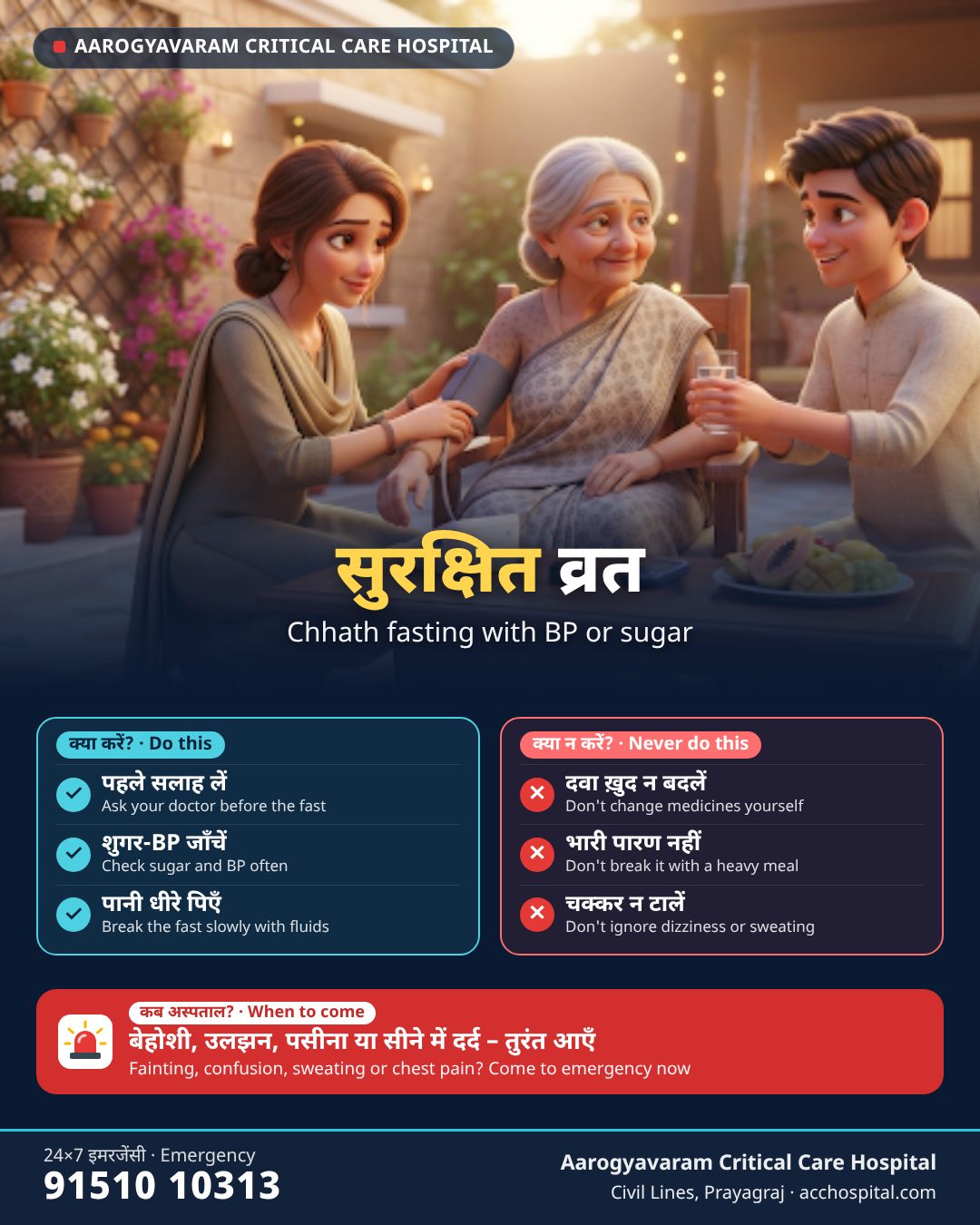
Chhath is observed with deep devotion by many families in Prayagraj, and the fast is one of the most demanding of the year – often a long stretch without food and, on the main days, without water. For a healthy adult this is tiring. For someone with diabetes (sugar), high blood pressure, heart disease or kidney disease, a long waterless fast can lead to very low or very high blood sugar, dehydration and a sudden fall in blood pressure. The one thing to remember: speak to your doctor a few days before the fast, and never stop or change your medicines on your own.
24×7 Emergency 📞 Call 91510 10313
What happens to the body during a long fast? (Lamba nirjala vrat aur sharir – kya hota hai?)
When we do not eat, the body first uses the sugar stored in the liver. After several hours it begins to break down fat for energy. When we also do not drink water, the body slowly loses fluid through breathing, sweat and urine, and the blood becomes more concentrated.
In a healthy person the body adjusts. But many common medicines work on the assumption that a person is eating and drinking normally:
- Sugar medicines and insulin keep lowering blood sugar even when no food is coming in. This can cause hypoglycaemia – sugar going dangerously low ("sugar low hona").
- If medicines are stopped suddenly, sugar can climb very high instead, especially with the stress of a long day.
- BP medicines and water tablets together with dehydration can make blood pressure drop, leading to giddiness and falls.
- Kidney and heart patients are sensitive to both too little and too much fluid.
This is why the same fast that is safe for one person can be risky for another – and why advice must be personal.
Symptoms and warning signs
Watch carefully for these signs during the fast, especially in elderly family members:
Low sugar (hypoglycaemia): - Sweating, shaking or trembling hands - Sudden hunger, palpitations (dil tez dhadakna), anxiety - Confusion, unusual behaviour, slurred speech - Drowsiness, fainting or fits
Dehydration and low BP: - Dizziness when standing up, feeling faint ("chakkar aana") - Very dry mouth, very little or dark urine - Headache, extreme tiredness, muscle cramps
Very high sugar: - Extreme thirst, frequent urination, nausea or vomiting - Drowsiness, fruity smell on the breath, fast breathing
Heart warning signs: - Chest pain, pressure or heaviness, pain spreading to the arm, jaw or back - Breathlessness or sweating with uneasiness
Who is at higher risk?
- People with diabetes, especially those on insulin or several sugar medicines
- People with high BP on more than one BP medicine or on water tablets
- Heart patients – after a heart attack, with angina or heart failure
- Kidney disease patients and those with past kidney stones
- Elderly people, especially those living alone or with memory problems
- Pregnant and breastfeeding women
- Anyone who has fainted, had a fall or had very low sugar during an earlier fast
First aid: what to do at home
- Before the fast – talk to your doctor. Do this a few days in advance. Ask whether a full waterless fast is safe for you, and exactly how to take your regular medicines on fasting days. Only your doctor can adjust doses.
- Check sugar and BP more often. If you have a home glucometer or BP machine, check in the morning, during the day and before breaking the fast. Keep a family member informed of the readings.
- If sugar is low (or low-sugar symptoms appear) and the person is awake and able to swallow, give something sweet straight away – glucose, sugar dissolved in water or a sweet drink – and then bring them to hospital. Health always comes before the fast; break it if your doctor or these signs say so.
- If the person faints, lay them flat in a cool, shaded place, raise the legs a little, loosen tight clothing and keep them on their side if they vomit. Do not pour anything into the mouth of a person who is not fully awake. Call for help and come to the emergency.
- Rest between rituals. Avoid standing for long periods in the sun or crowd. Sit down whenever you feel tired or light-headed.
- Break the fast slowly. Start with water, then a light drink and a small amount of light, easily digested food. Have the main meal later.
What not to do: common mistakes and myths
- Do not stop BP, sugar or heart medicines on your own because you are fasting. Stopping suddenly can be as dangerous as continuing without advice.
- Do not take extra medicine "to be safe". Do not double a dose before or after the fast.
- Do not ignore dizziness, sweating or shaking thinking it is "just weakness from the fast".
- Do not break a long fast with a large, oily or very sweet meal. This can cause acidity, vomiting, sugar spikes and, in heart patients, chest discomfort.
- Do not let an elderly person who lives alone fast without someone checking on them.
- Myth: "My sugar is normal, so the fast cannot harm me." Sugar that is controlled with medicines can still go very low when there is no food.
When to go to the emergency
Come to the emergency at once if there is:
- Fainting, fits, or the person is hard to wake
- Confusion, slurred speech, or weakness of one side of the body
- Sweating and shaking that does not settle quickly after sugar
- Chest pain, chest heaviness or breathlessness
- Repeated vomiting, or unable to keep fluids down after breaking the fast
- Very little urine for many hours, or severe dizziness on standing
- A fall with a head injury
Do not wait for the fast to end if these signs appear.
How doctors diagnose the problem
In the emergency the team quickly checks blood sugar with a finger-prick test, blood pressure, pulse and oxygen level. Depending on the situation, they may order blood tests for salts (sodium, potassium), kidney function and ketones, and an ECG if there is chest pain, breathlessness or palpitations. A brain scan may be needed if there are signs of a stroke or a head injury after a fall.
Treatment options
Treatment depends on the cause. Low sugar is corrected quickly, by mouth or through a drip. Dehydration and low BP are treated with fluids. Very high sugar needs careful correction of fluids, salts and sugar under monitoring, sometimes in the ICU. Heart-related chest pain is treated as an emergency. Once the person is stable, the doctor reviews the regular medicines and explains how to take them safely in future fasts.
Recovery and care at home
After an episode of low sugar or fainting, the person should rest for the rest of the day, eat regular light meals and drink enough fluid. Keep checking sugar and BP as your doctor advises and follow up with your physician before the next fast. If symptoms return, come back to the hospital.
Prevention
- Plan the fast with your doctor every year – medicines and health change over time.
- People at high risk can, after medical advice, choose a shorter or partial fast; many families support elders in this way.
- Eat a balanced, light meal before the fast begins rather than a heavy one.
- Keep a sweet drink or glucose nearby, and make sure one family member knows the warning signs.
- Keep the elderly away from long standing in cold water or crowds, and help them sit and rest.
Ayushman Bharat and cashless treatment
Aarogyavaram Critical Care Hospital is empanelled under Ayushman Bharat (PMJAY), and many private health insurance policies are accepted for cashless admission, as per the rules of the scheme or policy. Please bring your Ayushman card or insurance card and a photo ID when you come.
Frequently asked questions
Can a diabetic keep a nirjala fast on Chhath?
Some people with well-controlled diabetes can, but many cannot do a waterless fast safely, especially those on insulin. Speak to your doctor a few days before; they can tell you whether it is safe and how to adjust your medicines.
Should I stop my BP tablets during the Chhath fast?
No, not on your own. Some BP medicines may need a change on fasting days, but only your doctor can decide this. Stopping suddenly can make BP shoot up.
Vrat mein chakkar aa raha hai, kya karein?
Sit or lie down at once in a cool place and raise the legs. If the person is diabetic and awake, give something sweet. If dizziness does not settle, there is fainting, or chest pain, come to the emergency.
Vrat me sugar low ho jaye to kya kare?
If the person is awake and can swallow, give glucose or sugar in water straight away, then bring them to hospital. If they are drowsy or unconscious, do not put anything in the mouth – come to the emergency immediately.
How should I break the fast after Chhath?
Start with water and a light drink, then a small amount of light food. Have the full meal later. Avoid very oily, fried or sweet food at once, especially if you have diabetes, acidity or heart disease.
Is the Chhath fast safe for heart patients?
It depends on the heart condition. Heart patients should take their cardiologist's or physician's advice before any long or waterless fast. Chest pain or breathlessness during the fast is an emergency.
Buzurg ko vrat rakhna chahiye ya nahi?
Many elderly people fast with devotion. It is safer when their doctor has been consulted, when the fast is shortened if advised, and when a family member stays with them and watches for warning signs.
Pregnant women Chhath vrat rakh sakti hain?
A long waterless fast is generally not advised in pregnancy without medical advice. Please speak to your gynaecologist before deciding.
Aarogyavaram Critical Care Hospital, Prayagraj
Aarogyavaram Critical Care Hospital is on T.B. Sapru Marg, Civil Lines, Prayagraj, with a 24×7 emergency and ICU, and physician care for diabetes, blood pressure and fasting-related emergencies. We receive patients from across Prayagraj – Civil Lines, George Town, Katra, Allahpur, Tagore Town, Ashok Nagar, Kareli, Dhoomanganj, Teliyarganj, Rajapur, Mumfordganj, Kydganj, Chowk, Naini, Jhunsi, Phaphamau, Jhalwa, Bamrauli, Subedarganj and Preetam Nagar – and referrals from Kaushambi, Pratapgarh, Bhadohi, Mirzapur, Fatehpur, Chitrakoot, Banda, Jaunpur, Sultanpur, Varanasi, Rewa and Satna. 24×7 Emergency: 91510 10313.
This article is general health information, not medical advice. Diagnosis and treatment are decided by the treating doctor after examination. In an emergency, call 91510 10313 or go to the nearest hospital.