
Fever is one of the most common reasons families in Prayagraj come to hospital between July and November. Malaria, dengue and typhoid are all common in our city in this season, and all three can begin in the same way: fever, body ache, headache and tiredness. They are caused by different germs and need different treatment, so guessing at home or taking leftover medicines can delay the right care. The one thing to remember: a fever that lasts more than two days needs a doctor and a blood test, and some warning signs need the emergency the same hour.
24×7 Emergency 📞 Call 91510 10313
What are malaria, dengue and typhoid? (Malaria, dengue aur typhoid kya hai?)
Malaria is caused by a parasite that spreads through the bite of an infected Anopheles mosquito, which bites mostly at night. It classically causes fever with chills and shivering ("thand lag kar bukhar"), sweating, headache and body ache. Some types of malaria can affect the brain, kidneys and blood and become life-threatening.
Dengue is a viral infection spread by the Aedes mosquito, which bites during the day and breeds in clean, stored water – coolers, tyres, pots and flower vases. It causes high fever, severe body and joint pain ("haddi tod bukhar"), pain behind the eyes, rash and weakness. In some people the platelet count falls and fluid leaks from blood vessels, usually as the fever is coming down. This stage needs close watching.
Typhoid (enteric fever, "miyadi bukhar") is a bacterial infection spread through contaminated food and water. The fever often rises step by step over several days, with headache, stomach pain, loss of appetite, constipation or loose motions, and marked weakness. Without proper treatment it can cause serious complications in the intestine.
Symptoms and warning signs
Symptoms that can occur in any of the three:
- Fever, often high, sometimes with chills
- Headache and body ache
- Tiredness and loss of appetite
- Nausea or vomiting
- Stomach pain
Clues that point one way or another (only a test can confirm):
- Fever with shivering that comes and goes – think of malaria
- High fever with severe body pain, eye pain or rash – think of dengue
- Fever rising slowly over days with stomach upset – think of typhoid
Warning signs that need the emergency at once:
- Drowsiness, confusion, unusual behaviour or fits
- Bleeding from gums or nose, blood in vomit, or black stools
- Severe or constant stomach pain, or repeated vomiting
- Breathlessness or fast breathing
- Very little urine for 6 hours or more
- Cold, clammy hands and feet, giddiness or fainting
- Yellow eyes or dark urine
- A small child who is not feeding, is very sleepy or is breathing fast
Causes and who is at risk
- Mosquito breeding near homes, colonies and construction sites after the rains
- Stored water in coolers, drums, tyres and pots (dengue)
- Sleeping without nets or in open areas at night (malaria)
- Street food, cut fruit, unsafe water and ice (typhoid)
- Crowded gatherings and travel
People at higher risk of serious illness include young children, the elderly, pregnant women, and people with diabetes, kidney disease, heart disease or low immunity.
First aid: what to do at home
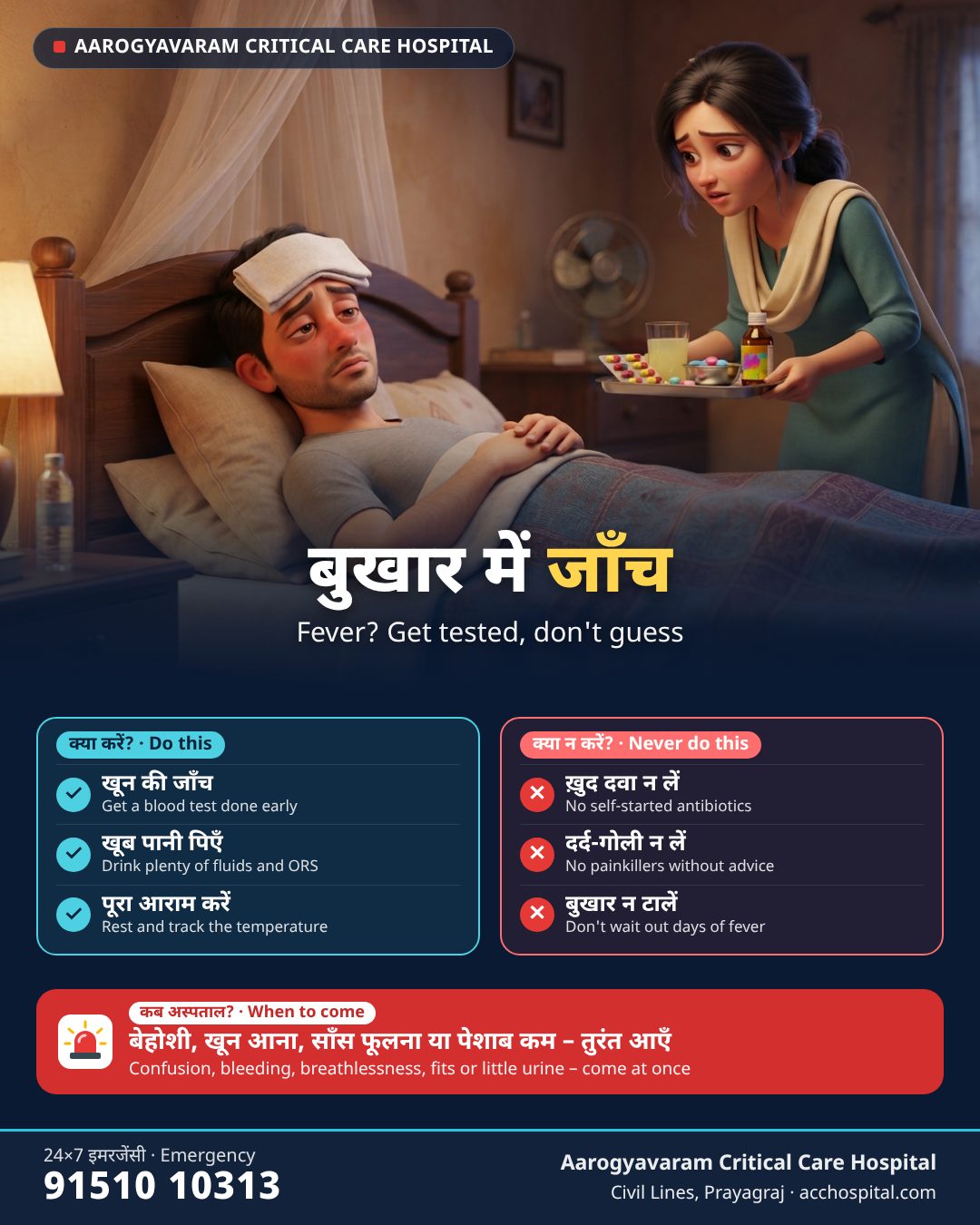
- Check the temperature with a thermometer and write it down morning and evening.
- Drink plenty of fluids – water, ORS, soup, daal water, coconut water and fresh juice.
- Rest fully. Do not go to work or school while the fever lasts.
- Sponge the body with normal tap water if the fever is high.
- Eat light, freshly cooked food such as khichdi, daliya and dal-rice.
- See a doctor if the fever lasts more than two days, or earlier if the person looks unwell, and get the blood tests advised.
- Keep a note of urine output, vomiting and any bleeding, and show it to the doctor.
What not to do: common mistakes and myths
- Do not start antibiotics on your own. Antibiotics do not work on dengue or malaria, and taking the wrong course for typhoid can hide the illness and make germs resistant.
- Do not take painkillers without medical advice. Some common pain medicines can increase the risk of bleeding in dengue.
- Do not rely only on home remedies. Papaya leaf juice, kiwi, goat milk and "kadha" do not replace testing and monitoring.
- Do not get injections or drips from unqualified people at home or at small clinics.
- Do not stop treatment early when the fever settles. Typhoid and malaria need the full course the doctor prescribes.
- Do not assume that the danger is over when the fever comes down in dengue – this is when warning signs often appear.
When to go to the emergency
Come to the emergency immediately – day or night – if there is:
- Drowsiness, confusion or fits
- Any bleeding, black stools or blood in vomit
- Breathlessness
- Repeated vomiting or being unable to drink
- Severe stomach pain
- Very little or no urine
- Cold hands and feet, giddiness or fainting
- Yellow eyes with high fever
- A child who is limp, not feeding or breathing fast
How doctors diagnose it
- Malaria: a rapid malaria test and a blood smear seen under the microscope.
- Dengue: an NS1 antigen test in the first few days, and antibody tests later.
- Typhoid: a blood culture is the most reliable test; other tests may be added.
- Complete blood count (CBC): to check platelets, white cells and haemoglobin.
- Liver and kidney tests, and sometimes an ultrasound of the abdomen or a chest X-ray, depending on the illness.
The Widal test alone is often misleading. Your doctor decides which tests are needed and when.
Treatment options
Treatment depends on the cause and how sick the person is. Malaria is treated with specific anti-malarial medicines. Typhoid is treated with suitable antibiotics chosen by the doctor. Dengue has no specific medicine; care is about fluids, rest, monitoring of platelets and blood pressure, and close watching for warning signs. People with warning signs may need admission for fluids through a drip, frequent tests and, in severe cases, intensive care. Platelet transfusion is given only when the doctor finds it necessary, not routinely.
Recovery and care at home
- Keep drinking plenty of fluids for several days after the fever settles.
- Eat light, nutritious food and increase it slowly.
- Complete the full course of medicines exactly as prescribed.
- Rest until strength returns – weakness after dengue and typhoid can last a few weeks.
- Return for follow-up tests if your doctor asks.
- Come back at once if fever returns or any warning sign appears.
Prevention
- Empty coolers, pots, tyres and containers every week; cover stored water.
- Use mosquito nets, full-sleeved clothes and mosquito repellents, especially for children.
- Keep windows screened and drains clean around the house.
- Drink boiled or filtered water and eat freshly cooked, hot food.
- Wash hands with soap before eating and after using the toilet.
- Ask your doctor about the typhoid vaccine for your family.
Ayushman Bharat and cashless treatment
Aarogyavaram Critical Care Hospital is empanelled under Ayushman Bharat (PMJAY), and cashless treatment is also available with many insurance companies and TPAs. Bring the patient's Ayushman card or insurance card and Aadhaar at admission; our desk completes verification as per the scheme. In an emergency, treatment comes first and paperwork follows.
Frequently asked questions
How do I know if my fever is dengue, malaria or typhoid?
You cannot tell reliably from symptoms alone. A doctor will examine the patient and advise blood tests such as an NS1 test, a malaria test and a blood culture.
Bukhar 3 din se hai, kya test karana chahiye?
Haan. Fever lasting more than two to three days should be checked by a doctor, who will advise tests like CBC, malaria test, dengue NS1 or typhoid culture.
Can I take antibiotics for fever at home?
No. Antibiotics do not help in viral fevers like dengue, and the wrong antibiotic can hide typhoid. Take them only when a doctor prescribes them.
Dengue mein platelets kitne kam hone par hospital jana chahiye?
The decision is not based on the number alone. Warning signs like bleeding, stomach pain, vomiting, drowsiness or low urine need the hospital at once, whatever the platelet count.
Is Widal test enough for typhoid?
Often not. The Widal test can be positive or negative for other reasons. A blood culture and the doctor's assessment are more reliable.
Does papaya leaf juice increase platelets?
There is no strong proof that it treats dengue. It must never replace testing, fluids and medical monitoring.
Malaria aur dengue ka bukhar kaise alag hai?
Malaria often comes with shivering and sweating in cycles, and dengue with severe body and eye pain and rash. But they overlap, so only a blood test can tell.
When should a child with fever be taken to the emergency in Prayagraj?
At once if the child is very sleepy, not feeding, breathing fast, has a fit, has bleeding or passes very little urine.
Aarogyavaram Critical Care Hospital, Prayagraj
Aarogyavaram Critical Care Hospital is on T.B. Sapru Marg, Civil Lines, Prayagraj, with a 24×7 emergency and ICU for adults and children with serious fever and infections. We receive patients from across Prayagraj – Civil Lines, George Town, Katra, Allahpur, Tagore Town, Ashok Nagar, Kareli, Dhoomanganj, Teliyarganj, Rajapur, Mumfordganj, Kydganj, Chowk, Naini, Jhunsi, Phaphamau, Jhalwa, Bamrauli, Subedarganj and Preetam Nagar – and referrals from Kaushambi, Pratapgarh, Bhadohi, Mirzapur, Fatehpur, Chitrakoot, Banda, Jaunpur, Sultanpur, Varanasi, Rewa and Satna. 24×7 Emergency: 91510 10313.
This article is general health information, not medical advice. Diagnosis and treatment are decided by the treating doctor after examination. In an emergency, call 91510 10313 or go to the nearest hospital.