
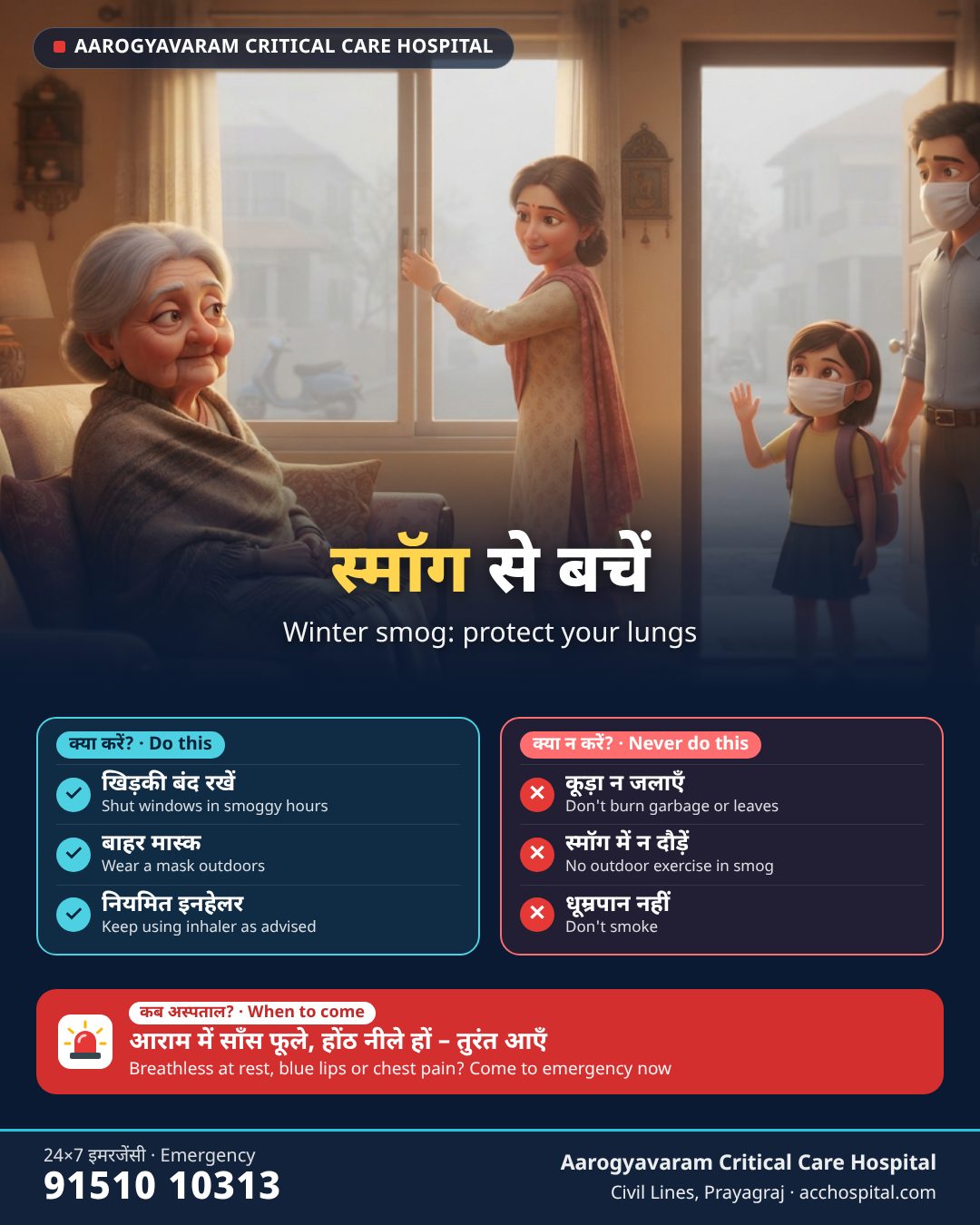
Every winter, the air in Prayagraj changes. On cold, still mornings and evenings, smoke from fires, vehicle fumes, construction dust and fog get trapped close to the ground and form a grey haze – smog. For healthy adults it may only mean an itchy throat. For children, elderly people, pregnant women and anyone with asthma, COPD or heart disease, it can trigger breathlessness, chest infections and even heart attacks. The one thing to remember: on heavy smog days, stay indoors with windows closed during the worst hours, and come to the emergency at once for breathlessness at rest, blue lips or chest pain.
24×7 Emergency 📞 Call 91510 10313
What is smog? (Smog kya hota hai?)
Smog is a mix of smoke and fog. In winter the ground cools fast at night, and a layer of cold air sits under warmer air above it. Pollution cannot rise and spread out, so it stays at breathing level, especially early in the morning and late in the evening. The most harmful part is very fine dust (often called PM2.5) – particles so small they go deep into the lungs and even into the blood. The Air Quality Index (AQI) shown on phone weather apps tells you how polluted the air is on a given day.
Symptoms and warning signs
Common effects of smog:
- Cough, sore or itchy throat
- Burning or watery eyes, runny nose
- Headache, tiredness
- Mild chest tightness on exertion
Warning signs that need urgent care:
- Breathlessness at rest or while talking
- Wheezing that does not settle with the usual inhaler
- Lips, tongue or nails turning blue or grey
- Chest pain or pressure, a racing heartbeat
- A child breathing very fast, with the ribs pulling in, or too breathless to feed
- Confusion or unusual drowsiness in an elderly person
- High fever with cough and breathlessness (possible pneumonia)
Causes and who is at risk
Winter smog in Prayagraj comes from burning of wood, coal, leaves and garbage, crop-residue smoke from the wider region, vehicle exhaust, construction and road dust, and festival smoke – all trapped by cold, still air.
People at higher risk:
- Children under five, whose lungs are still growing
- Elderly people
- Pregnant women
- People with asthma, COPD (chronic bronchitis), or other lung disease
- People with heart disease, high blood pressure or diabetes
- Smokers and people who work outdoors – traffic police, vendors, rickshaw pullers, construction workers
First aid: what to do at home
- Move indoors and close windows during smoggy early mornings and late evenings.
- Sit the person upright and keep them calm; loosen tight clothing.
- If they have asthma or COPD, use their regular reliever inhaler as their doctor has advised.
- Use steam or warm fluids for throat irritation if the person is fully awake.
- Watch closely. If breathing does not improve within a few minutes, or any warning sign appears, come to the emergency.
- Do not delay for a child or elderly person who is breathless – bring them in.
What not to do: common mistakes and myths
- Do not light an angithi, chulha or heater that burns wood or coal in a closed room – it can cause dangerous carbon monoxide poisoning.
- Do not burn leaves, garbage or plastic near the home.
- Do not go for a morning walk or run in heavy smog – walk later in the day or indoors.
- Do not depend on a handkerchief or thin cloth mask; it does little against fine dust.
- Do not stop regular inhalers or treatment because you feel better.
- Do not smoke, and do not let anyone smoke indoors.
- Do not ignore a cough with fever and breathlessness – it may be pneumonia.
When to go to the emergency
Come to the emergency at once if there is:
- Breathlessness at rest or difficulty speaking full sentences
- Blue or grey lips, tongue or nails
- Chest pain, pressure or a racing heartbeat
- Wheezing not relieved by the usual inhaler
- A child with fast breathing, ribs pulling in, or not feeding
- Confusion or drowsiness
- High fever with cough and breathlessness
How doctors diagnose it
The emergency team checks breathing rate, oxygen level with a finger clip (pulse oximeter), blood pressure and heart rate, and listens to the chest. Depending on the case, they may do a chest X-ray, ECG, blood tests and a blood gas test. For people with long-term lung problems, a breathing test (spirometry) is done later when they are stable.
Treatment options
Treatment depends on the cause. It may include oxygen, nebulisation and other medicines given in hospital to open the airways, treatment of any infection, and close monitoring. People with severe breathlessness may need ICU care and breathing support. Heart problems triggered by pollution are treated by the emergency and cardiac team. After recovery, the doctor reviews the long-term plan for asthma or COPD.
Recovery and care at home
After a smog-related flare-up, rest, keep follow-up visits, and use inhalers and treatment exactly as advised. Learn the correct inhaler technique – many people do not get the full benefit because of the wrong technique. Keep a written action plan: what to do on bad days and when to come in.
Prevention
- Check the AQI on your phone before going out; plan outdoor work and walks for the afternoon on bad days
- Keep children and elders indoors during heavy smog
- Wear a well-fitting N95-type mask outdoors on bad-air days
- Air the home in the afternoon when the air is clearer
- Never burn garbage, leaves or coal near the home
- Use clean cooking fuel and keep the kitchen ventilated
- Stop smoking, and keep the home smoke-free
- Get the yearly flu vaccine and ask your doctor about the pneumonia vaccine if you are elderly or have lung or heart disease
Ayushman Bharat and cashless treatment
Aarogyavaram Critical Care Hospital is empanelled under Ayushman Bharat (PMJAY), and many private health insurance policies are accepted for cashless admission, as per the rules of the scheme or policy. Our Ayushman/TPA desk confirms eligibility and handles the paperwork. Please bring your Ayushman card or insurance card and a photo ID.
Frequently asked questions
Is winter smog in Prayagraj harmful for health?
Yes. Fine dust in smog goes deep into the lungs and blood. It worsens asthma, COPD and heart disease, and causes cough and throat irritation even in healthy people.
Smog mein saans phoolne lage to kya karein?
Ghar ke andar aayein, seedhe baithein, aur agar asthma ka inhaler hai to doctor ki salah ke anusaar lein. Aaram mein bhi saans phoole ya honth neele padein to turant emergency aayein.
Which mask is best for air pollution?
A well-fitting N95-type mask filters fine dust far better than a cloth mask or handkerchief. It must fit snugly around the nose and chin.
Subah ki walk smog mein karna sahi hai?
Bhaari smog wale dinon mein subah-subah bahar walk na karein. Dopahar mein jab hawa saaf ho tab chalein, ya ghar ke andar halki kasrat karein.
Can air pollution cause a heart attack?
Heavy pollution can trigger heart attacks and irregular heartbeat in people with heart disease. Chest pain, sweating or breathlessness on a smoggy day should never be ignored.
Bachche ko pollution se khansi ho rahi hai, kab hospital laayein?
Agar bachcha tez saans le raha hai, pasliyan andar khinch rahi hain, doodh nahin pi pa raha ya bahut sust hai, to turant hospital laayein.
What is a good AQI level?
An AQI up to 50 is good and up to 100 is satisfactory. Above 200 is poor, and above 300 is very poor – limit outdoor time, especially for children and elders.
Angithi jalakar band kamre mein sona safe hai?
Nahin. Band kamre mein angithi ya koyle ka dhuaan carbon monoxide banata hai, jo jaan le sakta hai. Kamre mein hawa aane-jaane ka raasta rakhein.
Aarogyavaram Critical Care Hospital, Prayagraj
Aarogyavaram Critical Care Hospital is on T.B. Sapru Marg, Civil Lines, Prayagraj, with a 24×7 emergency and ICU, and care for breathing problems, chest infections and heart emergencies. We receive patients from across Prayagraj – Civil Lines, George Town, Katra, Allahpur, Tagore Town, Ashok Nagar, Kareli, Dhoomanganj, Teliyarganj, Rajapur, Mumfordganj, Kydganj, Chowk, Naini, Jhunsi, Phaphamau, Jhalwa, Bamrauli, Subedarganj and Preetam Nagar – and referrals from Kaushambi, Pratapgarh, Bhadohi, Mirzapur, Fatehpur, Chitrakoot, Banda, Jaunpur, Sultanpur, Varanasi, Rewa and Satna. 24×7 Emergency: 91510 10313.
This article is general health information, not medical advice. Diagnosis and treatment are decided by the treating doctor after examination. In an emergency, call 91510 10313 or go to the nearest hospital.