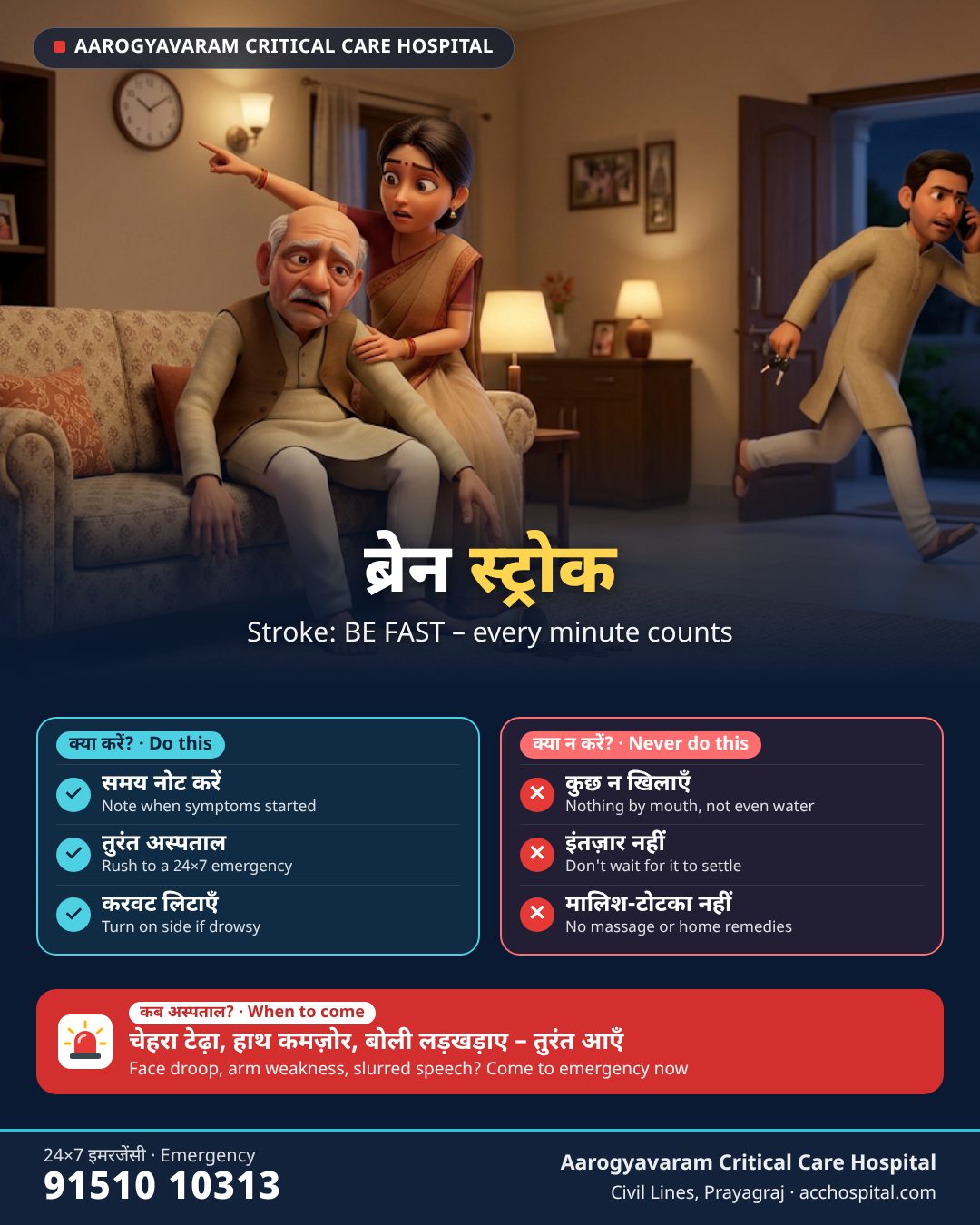
A brain stroke – often called paralysis, lakwa or "brain attack" – happens when blood supply to part of the brain suddenly stops. Brain cells start dying within minutes, so the time taken to reach a hospital decides how much of the brain can be saved. In Prayagraj, strokes are seen more in the winter months, when blood pressure tends to rise in the cold. The one thing to remember: if you see any BE FAST sign, note the time and go straight to a hospital with a 24×7 emergency and CT scan – do not wait to see if it gets better.
24×7 Emergency 📞 Call 91510 10313
What is a brain stroke? (Brain stroke ya lakwa kya hai?)
There are two main types. In an ischaemic stroke, a clot blocks a blood vessel in the brain; this is the more common type. In a haemorrhagic stroke, a weak blood vessel bursts and bleeds into the brain. A TIA (transient ischaemic attack), or "mini-stroke", causes the same signs but they go away within minutes or hours. A TIA is a serious warning: a bigger stroke may follow, so it needs emergency care just like a full stroke.
Symptoms and warning signs
Remember BE FAST:
- B – Balance: sudden loss of balance, dizziness or difficulty walking
- E – Eyes: sudden loss of vision, blurred or double vision in one or both eyes
- F – Face: one side of the face droops; the smile looks uneven
- A – Arm: sudden weakness or numbness of one arm or leg; one arm drifts down when both are raised
- S – Speech: slurred speech, words not coming out, or not understanding what others say
- T – Time: time to reach a hospital immediately – note the time the signs began
Other sudden signs include a severe headache unlike any before (especially with vomiting), confusion, sudden drowsiness, or a fit (seizure).
Causes and who is at risk
- High blood pressure – the single biggest risk factor
- Diabetes, high cholesterol and obesity
- Smoking and all forms of tobacco, and heavy alcohol use
- Irregular heartbeat (atrial fibrillation) and other heart disease
- Previous stroke or TIA, or a family history of stroke
- Older age, though strokes also happen in younger adults
- Stopping BP or blood-thinning medicines without advice
First aid: what to do at home
- Note the exact time the signs started – or the last time the person was seen normal. Doctors need this to decide treatment.
- Call for help and arrange transport at once. Take the person to a hospital that has a 24×7 emergency and CT scan.
- If the person is drowsy or vomiting, turn them on their side so they do not choke. Loosen tight clothing.
- Keep them calm and still, with the head slightly raised if they are awake.
- Carry their medicine list and reports (BP, sugar, blood thinners) to the hospital.
What not to do: common mistakes and myths
- Do not give anything by mouth – no water, tea, food, or tablets, including BP tablets or aspirin at home. Swallowing may be affected, and some strokes are bleeds.
- Do not wait for it to settle. Even if the signs disappear, it may be a TIA and needs checking at once.
- Do not waste time on massage, oil, local healers or home remedies. They cannot open a blocked vessel and they cost precious time.
- Do not put anything in the mouth during a fit.
- Do not let them sleep it off in the belief that rest will help.
When to go to the emergency
Go to the emergency immediately – day or night – if any one of these appears suddenly:
- Face drooping, arm or leg weakness, or slurred speech
- Sudden loss of balance or vision
- Worst-ever headache, confusion, drowsiness or a fit
- Any BE FAST sign that came and went in a few minutes
How doctors diagnose it
In the emergency, the team checks breathing, BP, sugar and the nervous system quickly. A CT scan of the brain is usually done first to see whether it is a clot or a bleed – this decides the treatment. Blood tests, ECG and sometimes an MRI or scans of the neck vessels follow.
Treatment options
For a clot-type stroke, a clot-dissolving medicine may be given if the patient reaches early enough and the doctor finds it suitable – this is why the "golden hours" matter. Some patients may be considered for a procedure to remove the clot. For a bleed, care focuses on controlling BP, monitoring in the ICU and sometimes surgery. All patients need careful monitoring, prevention of complications, and early rehabilitation. Recovery differs from person to person.
Recovery and care at home
- Start physiotherapy, speech and swallowing therapy as advised – early rehabilitation helps
- Take BP, sugar, cholesterol and blood-thinning medicines exactly as prescribed
- Prevent falls at home: clear the floor, use support rails, keep a light on at night
- Watch for swallowing trouble; give food and liquids only as the care team advises
- Watch for low mood after stroke and speak to the doctor about it
Prevention
- Check BP regularly and keep it under control, especially in winter
- Control sugar and cholesterol, and take medicines regularly
- Stop smoking and all tobacco; limit alcohol
- Walk daily, eat less salt and fried food, and keep a healthy weight
- If you have an irregular heartbeat, follow your doctor's advice on blood thinners
Ayushman Bharat and cashless treatment
Aarogyavaram Critical Care Hospital is empanelled under Ayushman Bharat (PMJAY). Our Ayushman / TPA desk confirms eligibility and handles the paperwork for cashless treatment with participating insurers.
Frequently asked questions
Stroke ke lakshan kya hote hain?
Remember BE FAST: Balance loss, Eyes (vision loss), Face drooping, Arm weakness, Speech trouble, Time to reach hospital. Any one of these, appearing suddenly, needs emergency care.
What is the golden hour in stroke?
It is the early period after a stroke when treatment can save the most brain. Some treatments work only within a few hours of onset, so reach hospital as fast as you can.
Lakwa maarne par turant kya karein?
Note the time, keep the person on their side if drowsy, give nothing by mouth, and take them straight to a hospital with 24×7 emergency and CT scan.
Can stroke symptoms go away on their own?
Sometimes they disappear within minutes – this is called a TIA or mini-stroke. It is a warning sign of a bigger stroke and needs emergency checking at once.
Stroke mein pani ya dawai de sakte hain?
No. Swallowing may be affected and the person can choke. Do not give water, food or tablets until doctors assess them.
Why does stroke increase in winter?
In cold weather, blood vessels narrow and BP can rise, which increases the risk. Keep warm, check BP more often and keep taking medicines.
Brain stroke treatment in Prayagraj – where to go?
Go to the nearest hospital with a 24×7 emergency, CT scan and ICU. Do not wait for a clinic appointment.
Kya stroke ke baad theek ho sakte hain?
Many people improve with early treatment and regular physiotherapy, though recovery differs for each person. Starting rehabilitation early and preventing a second stroke both matter.
Aarogyavaram Critical Care Hospital, Prayagraj
Aarogyavaram Critical Care Hospital is at Civil Lines, Prayagraj, with a 24×7 emergency and ICU. Families from across Prayagraj – including Civil Lines, George Town, Katra, Naini, Jhunsi, Phaphamau and nearby areas – can reach us at any hour. Emergency number: 91510 10313.
This article is general health information, not medical advice. Diagnosis and treatment are decided by the treating doctor after examination. In an emergency, call 91510 10313 or go to the nearest hospital.