
Scrub typhus is a bacterial fever spread by the bite of tiny mite larvae, called chiggers, that live in grass, bushes and farm land. It is seen in many parts of Uttar Pradesh from the monsoon until early winter – now in cities like Prayagraj too, not only in villages – and because it starts like any other fever, it is often mistaken for dengue, malaria or typhoid. The one thing to remember: a fever lasting more than two days needs a doctor, even if you have not been near a field – lawns, parks and empty plots in the city can carry these mites – and look for a small black scab on the body.
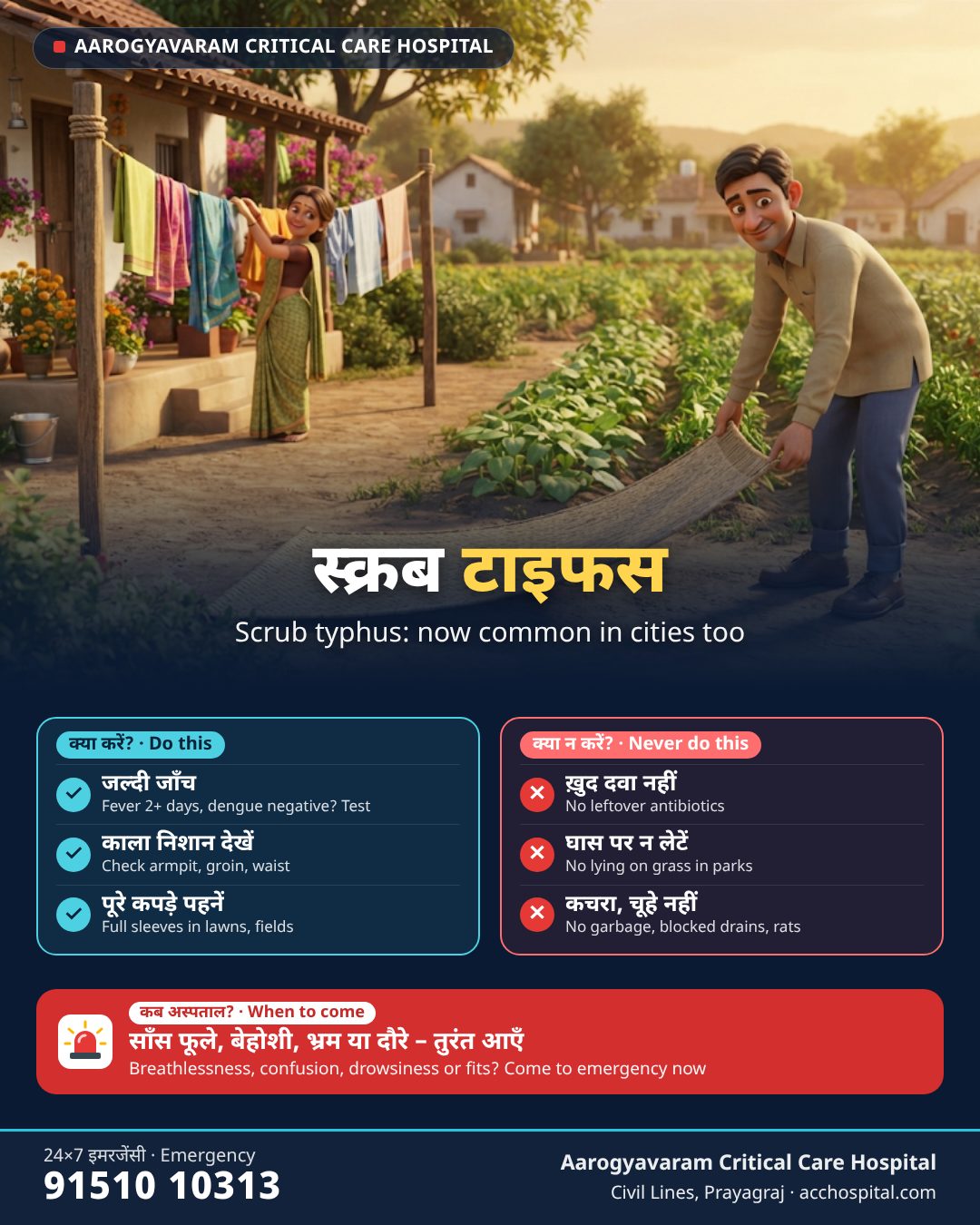
24×7 Emergency 📞 Call 91510 10313
What is scrub typhus? (Scrub typhus kya hai?)
Scrub typhus is an infection caused by a bacterium called Orientia tsutsugamushi. It is passed to people when an infected chigger bites the skin. The bite is painless, so most people never notice it. A few days to about two weeks later, fever begins.
It does not spread from person to person.
The illness responds to the right treatment when it is found early. When it is missed, it can affect the lungs, brain, kidneys, liver and blood pressure, and some patients need intensive care.
Symptoms and warning signs
Scrub typhus usually begins suddenly. Common symptoms are:
- High fever, often with chills
- Severe headache
- Body ache and muscle pain
- Red eyes
- Swollen, tender glands in the neck, armpit or groin
- A rash on the body in some people
- Dry cough
The black scab (eschar). Many patients have a small, painless, round black scab, like a cigarette burn, at the place where the chigger bit. It is often hidden in skin folds – the armpit, groin, waist line, under the breasts, behind the ears or around the genitals – so it is easily missed. Not every patient has it, but when present it is a strong clue. Always tell the doctor if you find one.
Warning signs of serious illness:
- Breathlessness or fast breathing
- Confusion, unusual sleepiness, or behaviour change
- Fits (seizures)
- Very little urine
- Yellow eyes or skin
- Fainting, cold hands and feet, or very low blood pressure
- Bleeding from any site
- A falling platelet count on a blood test
Causes and who is at risk
The infection comes from chiggers living in vegetation. People are more likely to be bitten when they:
- Work in fields, orchards or vegetable gardens
- Cut grass or clear bushes
- Sit or lie directly on grass, or dry clothes on bushes
- Live in houses with overgrown vegetation around them
Farmers, gardeners, labourers, children who play in grassy areas, and families on the outskirts and villages around Prayagraj – such as Phaphamau, Naini, Jhunsi, Soraon and Handia – may be at higher risk.
Scrub typhus in the city: not only a village illness
Scrub typhus is now common in urban Prayagraj too. Because families think of it as a farm illness, it is often not suspected.
Why it is spreading in the city:
- Rats, shrews and blocked drains. The mite larvae feed on rats and shrews. Blocked or encroached drains, waterlogging and open garbage increase rodent numbers, and rodents carry the mites into lanes, courtyards and homes.
- Post-monsoon weeds and greenery. Humid weather and thick weeds on vacant plots, construction sites, river and nala banks, railway lines and unmaintained parks keep the mites alive until November.
- Lawns and kitchen gardens. Home lawns, flower beds and overgrown boundaries of colonies, hostels, offices and campuses can also hold the mites.
- Growing city edges. New colonies in areas like Naini, Jhunsi and Phaphamau sit right next to fields, so farm mites are close to homes.
- More testing. More labs now test for scrub typhus when fever continues and dengue and malaria are negative, so cases that were once called "viral fever" are being found.
Walkers in parks, children playing on grass, gardeners and domestic helpers can be bitten without noticing. If anyone in the family has a fever that does not settle, think of scrub typhus even if no one has been to a village or a field.
Complications and who needs extra care
When diagnosis is late, scrub typhus can lead to pneumonia and breathing failure, brain involvement (meningitis or encephalitis, with confusion or fits), kidney injury, jaundice, low blood pressure and shock. Children, elderly people, pregnant women and people with diabetes, kidney, liver or heart disease should see a doctor early, as the illness can become serious faster in them.
First aid: what to do at home
- Note when the fever started and check the temperature regularly.
- Give plenty of fluids – water, ORS, soups and coconut water – to prevent dehydration.
- Carefully check the whole skin, including the armpits, groin, waist and behind the ears, for a black scab.
- If fever lasts more than two days, or comes with a rash, swollen glands or a black scab, see a doctor the same day.
- Tell the doctor about any recent work or time in fields, gardens or bushy places.
- Keep a record of any medicines already taken and show it to the doctor.
What not to do: common mistakes and myths
- Do not take leftover antibiotics or medicines bought without a prescription. The wrong medicine can hide the illness without treating it.
- Do not wait for the fever to settle on its own for many days. Delay is the main reason scrub typhus becomes serious.
- Do not depend only on home remedies. Fluids and rest help, but they do not treat the infection.
- Myth: "Dengue and malaria are negative, so it is just viral fever." Scrub typhus needs its own test. If fever continues, ask the doctor about it.
When to go to the emergency
Come to the emergency at once if a person with fever has any of these:
- Breathlessness or fast breathing
- Confusion, drowsiness, or unusual behaviour
- Fits
- Very little urine or no urine
- Yellow eyes
- Fainting, dizziness on standing, cold and clammy skin
- Persistent vomiting, unable to keep fluids down
- Bleeding from gums, nose, or in urine or stool
- A small child, an elderly person or a pregnant woman with high fever who looks unwell
Do not wait for the morning if these signs appear at night. Aarogyavaram Critical Care Hospital at Civil Lines, Prayagraj runs a 24×7 emergency service.
How doctors diagnose it
The doctor examines the patient, including looking for the black scab. Tests may include:
- Blood count and liver and kidney tests to see how the body is affected
- A blood test for scrub typhus (an antibody test such as IgM ELISA, or in some cases a PCR test)
- Tests for dengue, malaria and typhoid to rule out other common fevers
- Chest X-ray if there is cough or breathlessness
The antibody test may be negative in the first few days, so the doctor may treat based on symptoms and the black scab.
Treatment options
Scrub typhus is treated with specific antibiotics chosen by the doctor. The choice and duration depend on the patient's age, pregnancy and severity of illness. Early, mild illness can often be treated with tablets and close follow-up.
Patients with warning signs may need hospital admission for intravenous medicines, fluids, oxygen and monitoring. A small number need intensive care – for example, breathing support, blood pressure support, or dialysis if the kidneys are affected. Aarogyavaram Critical Care Hospital has a 24×7 emergency and ICU for patients who need this level of care.
Never start or stop antibiotics without a doctor's advice.
Recovery and care at home
- Complete the full course of medicine exactly as prescribed.
- Keep drinking enough fluids and eat light, nourishing food.
- Rest until the fever settles and strength returns. Tiredness may last a little longer.
- Return to hospital if fever comes back, or if any warning sign appears.
Prevention
There is no vaccine for scrub typhus, so prevention depends on avoiding chigger bites:
- Wear full-sleeved shirts, long trousers and closed shoes in fields, gardens, parks, river banks or grassy areas. Tuck trousers into socks.
- Avoid sitting or lying directly on grass; use a mat or sheet.
- Do not dry clothes on bushes or grass.
- Keep the area around the house clear of tall grass, weeds and bushes.
- Keep drains clear and garbage covered. Rat-proof the home: seal holes and gaps, and store food and grain in closed containers.
- Bathe and wash clothes after field or garden work.
- Use an insect repellent on exposed skin as advised on the product label.
Ayushman Bharat and cashless treatment
Aarogyavaram Critical Care Hospital is empanelled under Ayushman Bharat (PMJAY). Our Ayushman / TPA desk confirms eligibility and handles the paperwork for cashless treatment with participating insurers.
Frequently asked questions
What is scrub typhus fever?
Scrub typhus is a bacterial fever spread by the bite of tiny mites called chiggers that live in grass and bushes. It causes high fever, headache, body ache and often a small black scab.
Scrub typhus ke lakshan kya hain?
Tez bukhar, sir dard, badan dard, aankhon mein laali, gilti (swollen glands) aur aksar sharir par ek chhota kaala nishaan. Saans phoolna, behoshi ya bhram ho to turant emergency jaayein.
Where does the black scab of scrub typhus appear?
It is often in hidden skin folds – the armpit, groin, waist line, under the breasts or behind the ears. It is painless, so check carefully.
Can scrub typhus happen in cities?
Yes. It is now common in urban Prayagraj too. The mites live in weeds, lawns, parks and vacant plots and are carried by rats from blocked drains and garbage, so city families can get it without visiting a village.
Is scrub typhus contagious?
No. It does not spread from one person to another. It spreads only through the bite of an infected chigger.
Fever hai, dengue malaria negative hai – kya scrub typhus ho sakta hai?
Haan, ho sakta hai. Bukhar do din se zyada rahe to doctor se scrub typhus ki jaanch ke baare mein poochhein.
Which test is done for scrub typhus?
Doctors commonly use an antibody blood test such as IgM ELISA, sometimes a PCR test, along with blood counts and tests for other fevers.
Can scrub typhus be treated at home?
Mild cases found early may be treated with tablets prescribed by a doctor, with close follow-up. Patients with warning signs need hospital care. Never treat it with leftover medicines.
Scrub typhus se kaise bachein?
Khet ya bagiche mein poore kapde pehnein, ghaas par seedhe na baithein ya letein, kapde jhaadiyon par na sukhayein aur ghar ke aaspaas jhaadiyan saaf rakhein.
Aarogyavaram Critical Care Hospital, Prayagraj
Aarogyavaram Critical Care Hospital is at Civil Lines, Prayagraj, with a 24×7 emergency and ICU. Families from across Prayagraj – including Civil Lines, George Town, Katra, Naini, Jhunsi, Phaphamau and nearby areas – can reach us at any hour. Emergency number: 91510 10313.
This article is general health information, not medical advice. Diagnosis and treatment are decided by the treating doctor after examination. In an emergency, call 91510 10313 or go to the nearest hospital.