
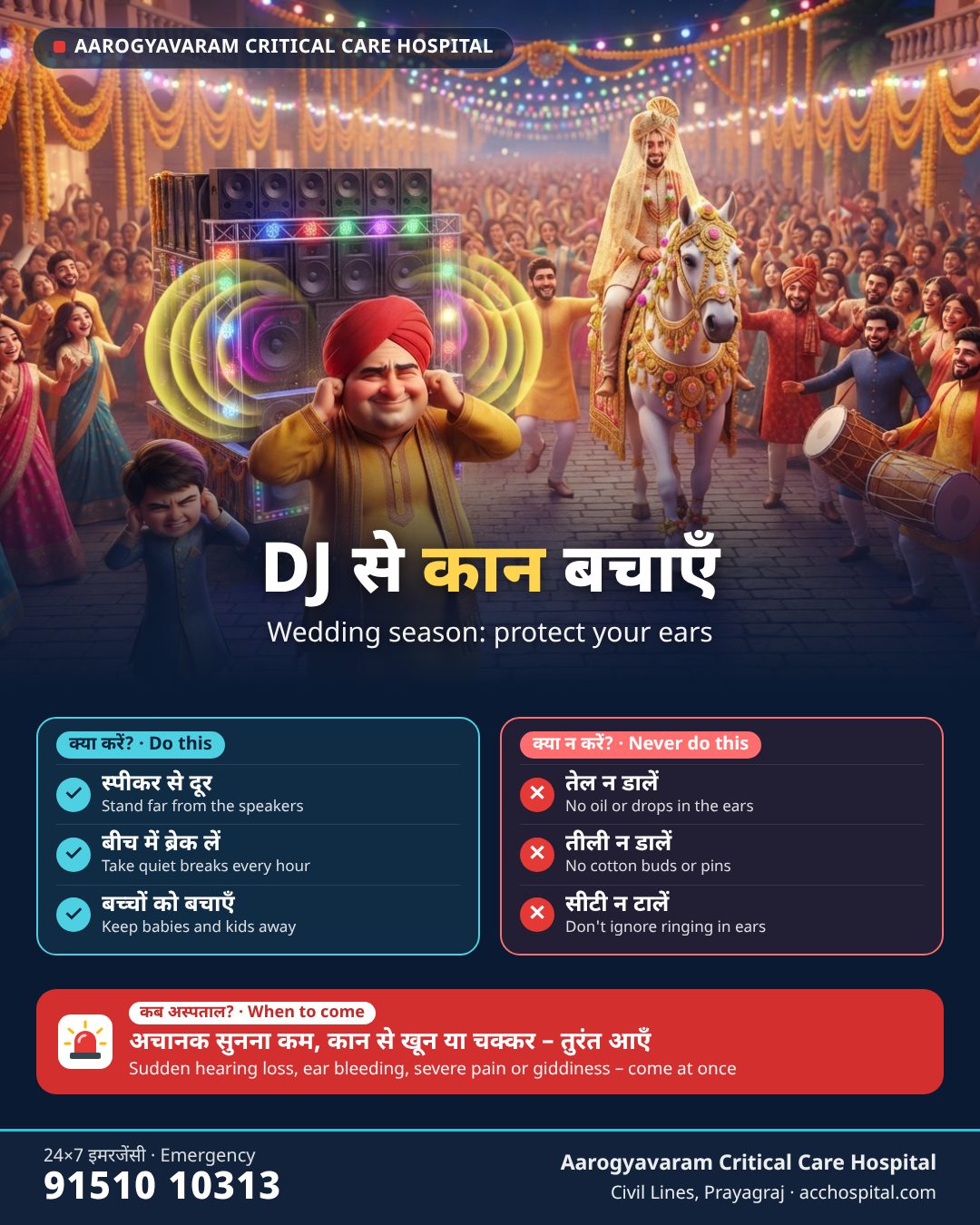
November to February is the wedding season in Prayagraj. Baraats, sangeet nights, jagrans and parties bring DJ speakers and sound boxes played at very high volume, often late into the night and for many hours. Very loud sound can damage the inner ear, and this kind of hearing loss – called noise-induced hearing loss – may not recover. The one thing to remember: ringing, buzzing or a blocked feeling in the ears after a function is a warning, and a sudden drop in hearing needs medical attention the same day.
24×7 Emergency 📞 Call 91510 10313
What is noise-induced hearing loss? (Tez awaaz se kaan kharab hona kya hai?)
Deep inside the ear is the cochlea, which contains thousands of tiny hair cells. These cells turn sound into signals that the brain understands. Very loud sound, or loud sound for a long time, can injure or kill these cells. Once they are lost, the body cannot grow them back.
Noise damage can happen in two ways:
- Long, repeated exposure – for example, standing near DJ speakers at function after function, or working in loud places. The loss builds up slowly and is often noticed only years later.
- A single very loud blast – a speaker suddenly turned up close to the ear, or a loud cracker or explosion near the head. This can cause sudden hearing loss, ear pain and sometimes a torn eardrum.
Tinnitus ("kaan mein seeti bajna" or "kaan mein ghanti") – a ringing, buzzing or hissing sound in the ears – is a common sign that the ear has been stressed by noise.
Symptoms and warning signs
Common symptoms after a loud function:
- Ringing, buzzing or whistling in one or both ears
- A muffled or blocked feeling, as if the ears are full ("kaan band lagna")
- Difficulty hearing conversation, especially in a crowd
- Needing the TV or phone louder than before
- Discomfort or pain with ordinary loud sounds
Warning signs that need the emergency or a same-day medical check:
- Sudden loss of hearing in one or both ears
- Bleeding or fluid coming from the ear
- Severe ear pain
- Giddiness, spinning (vertigo) or loss of balance
- Ringing with headache, vomiting or weakness
- Ringing or muffled hearing that has not settled by the next day
Causes and who is at risk
- Standing or dancing right next to DJ speakers and sound boxes
- Long functions with music playing for hours without a break
- Loud music in closed halls, cars and rooms
- Earphones played at high volume for long periods
- Loud crackers and fireworks near the head
- Work in noisy places – generators, factories, construction, band and DJ work
People at higher risk include:
- Babies and young children, whose ears are more sensitive and who cannot move away on their own
- Elderly people, who may already have some age-related hearing loss
- DJ operators, band members, tent and sound workers exposed every night of the season
- People with earlier ear disease or ear surgery
First aid: what to do at home
- Move away from the noise at once and rest in a quiet room.
- Keep the ears dry and leave them alone – do not put anything inside.
- Avoid further loud sound, earphones and loud TV for the next few days.
- If there is bleeding or fluid from the ear, cover the outer ear loosely with a clean, dry cloth and come to hospital.
- If ringing or muffled hearing does not settle by the next day, see a doctor.
- If hearing drops suddenly, come the same day – early treatment matters.
What not to do: common mistakes and myths
- Do not put oil, garlic oil, onion juice or any drops in the ears. They do not help noise damage and can cause infection, especially if the eardrum is torn.
- Do not use cotton buds, hairpins, matchsticks or keys to clean or scratch the ears.
- Do not ignore ringing that lasts into the next day – it is a sign of damage.
- Do not wait for weeks if hearing has suddenly dropped. Treatment works best when started early.
- Do not go back to loud functions while the ears are still ringing.
- Myth: "You get used to loud music." The ears do not toughen up; they are damaged a little more each time.
When to go to the emergency
Come to the emergency at once if there is:
- Sudden hearing loss in one or both ears
- Bleeding or watery discharge from the ear
- Severe ear pain after a loud blast or a slap to the ear
- Giddiness, spinning or loss of balance
- Ear symptoms with severe headache, vomiting, face weakness or confusion
- Any ear injury after a cracker or explosion
How doctors diagnose it
- Ear examination with a lighted instrument to look at the ear canal and eardrum.
- Tuning fork tests at the bedside to tell the type of hearing loss.
- Audiometry (hearing test) to measure how much hearing is affected at different pitches.
- Other tests, such as impedance testing or scans, only if the doctor feels they are needed.
Treatment options
Treatment depends on the type and cause of the hearing loss. Sudden hearing loss is treated as urgent, and the ENT doctor may start medicines early. A torn eardrum often heals on its own if the ear is kept dry and free of infection, and some need a minor procedure. For long-standing noise damage, the focus is on protecting the remaining hearing; hearing aids and counselling can help people hear and communicate better. Ringing in the ears can be managed with advice, sound therapy and treatment of any cause found. Your doctor will explain what is suitable for your situation.
Recovery and care at home
- Rest the ears – avoid loud places, earphones and loud TV until the doctor says it is safe.
- Keep the ear dry if the eardrum is injured; cover it while bathing as advised.
- Take medicines only as prescribed and complete the course.
- Return for the follow-up hearing test.
- Come back at once if hearing gets worse, pain increases or there is discharge or fever.
Prevention
- Stand or sit at least a few metres away from speakers, never in front of them.
- Take a break in a quiet place every hour at a function.
- Keep babies and children away from the dance floor and speaker area.
- Use simple foam ear plugs if you must be near loud music for a long time – DJ and band workers should use them every night.
- Ask organisers to keep the volume reasonable and to place speakers away from seating, elderly guests and children.
- Keep earphone volume low and take breaks.
- If you notice that you often ask people to repeat themselves, get a hearing test.
Ayushman Bharat and cashless treatment
Aarogyavaram Critical Care Hospital is empanelled under Ayushman Bharat (PMJAY), and cashless treatment is also available with many insurance companies and TPAs. Bring the patient's Ayushman card or insurance card and Aadhaar at admission; our desk completes verification as per the scheme. In an emergency, treatment comes first and paperwork follows.
Frequently asked questions
Can loud DJ music cause permanent hearing loss?
Yes. Very loud sound can permanently damage the hair cells of the inner ear. Repeated exposure adds up, so protecting your ears at every function matters.
Shaadi ke baad kaan mein seeti baj rahi hai, kya karein?
Rest the ears in a quiet place and avoid loud sound. If the ringing has not settled by the next day, or hearing is reduced, see a doctor.
Is ringing in the ears after a party normal?
It is common but it is a warning sign that the ears were stressed. Ringing that lasts more than a day needs a medical check.
Kaan band lag raha hai DJ ke baad, tel daal sakte hain?
No. Do not put oil or any drops in the ear. It does not help noise damage and can cause infection. See a doctor if the blocked feeling continues.
What is sudden hearing loss and why is it urgent?
It is a quick drop in hearing, usually in one ear, over hours or a few days. Treatment works best when started early, so come the same day.
How far should I stand from DJ speakers?
As far as practical – at least a few metres, never right in front. If you need to shout to talk to someone next to you, it is too loud.
Are babies at risk from loud music at weddings?
Yes. Babies and young children have sensitive ears and cannot move away themselves. Keep them away from speakers and leave the area if they seem upset by the noise.
Bachche ke kaan se khoon aa raha hai, kya karein?
Do not put anything inside the ear. Cover the outer ear loosely with a clean cloth and bring the child to the emergency at once.
Aarogyavaram Critical Care Hospital, Prayagraj
Aarogyavaram Critical Care Hospital is on T.B. Sapru Marg, Civil Lines, Prayagraj, with a 24×7 emergency and ICU, and ENT care for ear injuries and emergencies. We receive patients from across Prayagraj – Civil Lines, George Town, Katra, Allahpur, Tagore Town, Ashok Nagar, Kareli, Dhoomanganj, Teliyarganj, Rajapur, Mumfordganj, Kydganj, Chowk, Naini, Jhunsi, Phaphamau, Jhalwa, Bamrauli, Subedarganj and Preetam Nagar – and referrals from Kaushambi, Pratapgarh, Bhadohi, Mirzapur, Fatehpur, Chitrakoot, Banda, Jaunpur, Sultanpur, Varanasi, Rewa and Satna. 24×7 Emergency: 91510 10313.
This article is general health information, not medical advice. Diagnosis and treatment are decided by the treating doctor after examination. In an emergency, call 91510 10313 or go to the nearest hospital.