
Chronic kidney disease (CKD) means the kidneys slowly lose their ability to clean the blood over months or years. It is one of the most "silent" illnesses: most people feel completely normal until a large part of kidney function is already gone. In Prayagraj, as in the rest of India, the biggest causes are long-standing high blood pressure and diabetes – which many families already live with. The one thing to remember: if you have BP or sugar, a simple urine test and a creatinine blood test, done as your doctor advises, can pick up kidney damage years before symptoms appear.
24×7 Emergency 📞 Call 91510 10313
What is chronic kidney disease? (Kidney ki bimari ya CKD kya hai?)
We have two kidneys, each about the size of a fist, just below the ribs at the back. They filter waste and extra water out of the blood to make urine, keep salt and potassium in balance, help control blood pressure, and help the body make red blood cells and keep bones healthy.
In chronic kidney disease, this filtering slowly gets weaker. Doctors measure it with a number called eGFR, which is calculated from the blood creatinine test, and with a urine test for protein (albumin). CKD is described in stages, from mild (stage 1–2) to kidney failure (stage 5), when dialysis or a kidney transplant may be needed.
CKD is different from acute kidney injury (AKI), where the kidneys stop working suddenly – for example after severe dehydration, a serious infection, some medicines or poisoning. AKI is an emergency, but with timely treatment the kidneys can often recover.
Symptoms and warning signs
In the early stages, there are usually no symptoms at all. That is why testing matters. As the disease progresses, people may notice:
- Swelling of the feet, ankles, around the eyes or the face (puffy face in the morning)
- Passing urine more often at night
- Foamy or frothy urine (a sign of protein leaking)
- Less urine than usual, or dark or blood-tinged urine
- Tiredness, weakness and feeling cold (often due to anaemia)
- Poor appetite, nausea, a metallic taste in the mouth
- Dry, itchy skin
- Breathlessness, especially on lying down, because of fluid build-up
- Blood pressure that becomes hard to control
- Muscle cramps, poor sleep or difficulty concentrating
Many of these signs are vague and are easily blamed on age, winter or "weakness". If you have BP or diabetes and notice them, get your kidney tests done instead of guessing.
Causes and who is at risk
The most common causes are:
- Diabetes – high sugar over years damages the tiny filters in the kidneys
- High blood pressure – both a cause and a result of kidney disease
- Long-term or frequent use of painkillers (NSAIDs) without medical advice
- Kidney stones and repeated urine infections or blockages, including prostate enlargement in older men
- Glomerulonephritis and other inflammatory kidney diseases
- Polycystic kidney disease and other inherited conditions
- Some unproven herbal or metal-containing remedies
You are at higher risk if you have diabetes or high BP, are above 60, are obese, smoke or use tobacco, have heart disease, have a family member with kidney disease or on dialysis, or had kidney problems as a child or during pregnancy.
First aid: what to do at home
CKD is not a first-aid illness – it needs regular medical care. But these steps protect your kidneys every day:
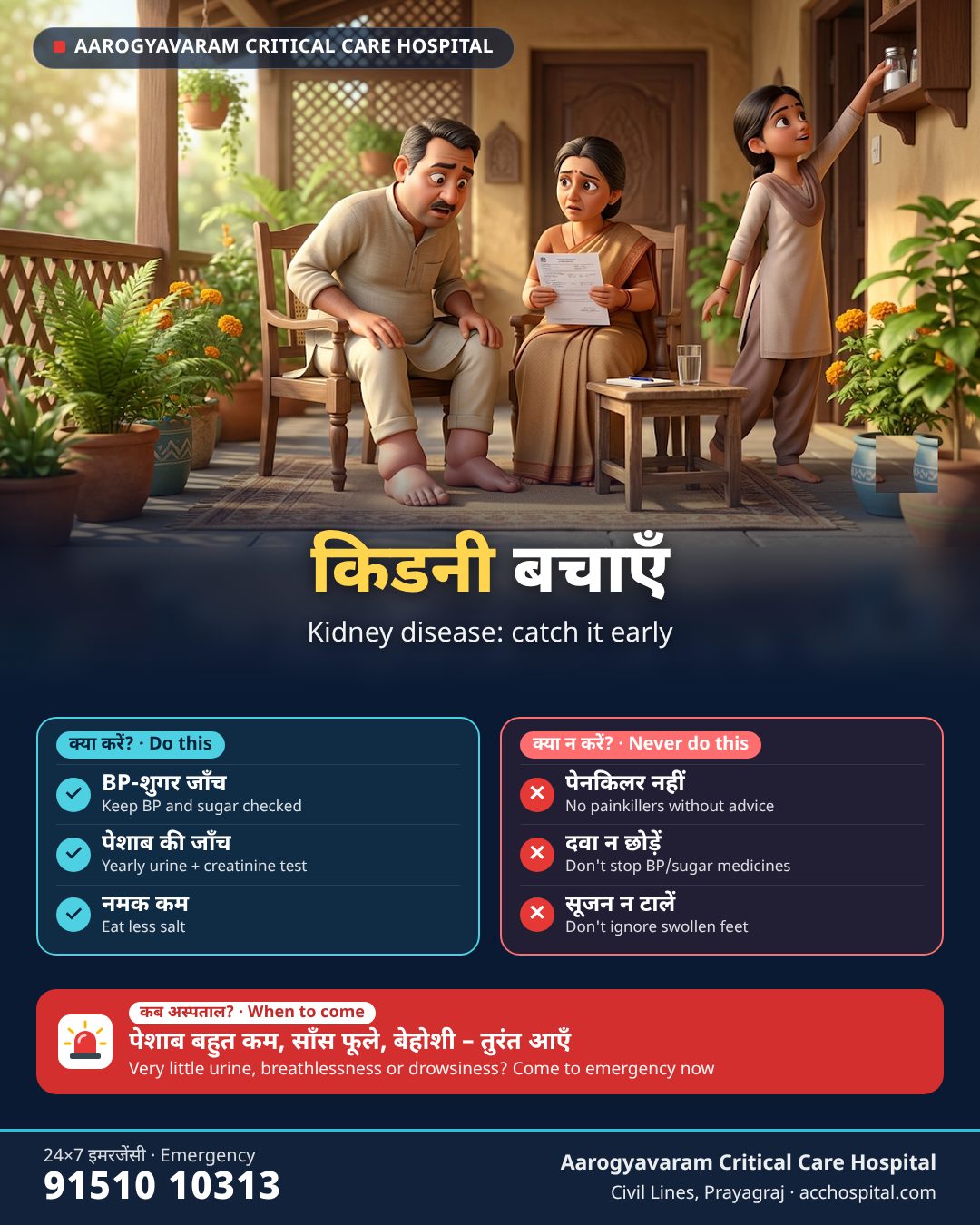
- Know your numbers. Keep a record of your BP, sugar and the latest creatinine/eGFR and urine protein results, and carry them to every doctor visit.
- Take BP and diabetes medicines regularly, exactly as prescribed. Some BP medicines also protect the kidneys.
- Cut down salt – less salt in cooking, and fewer pickles, papad, namkeen and packaged snacks.
- Drink fluids as your doctor advises. Most people need normal amounts of water; people with advanced CKD or heart failure may be told to limit fluids.
- Tell every doctor that you have kidney disease before they prescribe new medicines, and before any scan that uses contrast dye.
- Watch for warning signs such as reduced urine, sudden swelling or breathlessness, and act quickly.
What not to do: common mistakes and myths
- Do not take painkillers often without advice. Regular use of common painkillers for body ache, knee pain or headache can damage the kidneys, especially in older people and people with BP or diabetes.
- Do not stop BP or sugar medicines on your own because readings "look normal". Normal readings often mean the medicine is working.
- Do not trust "kidney cleanse" or "kidney detox" products or unverified herbal powders. Some contain substances that can harm the kidneys.
- Myth: "Drinking lots of water cures kidney disease." Fluids should be as your doctor advises – too much can be harmful in advanced CKD.
- Myth: "Once dialysis starts, it can never stop." In sudden kidney injury, dialysis may be temporary. In advanced CKD it is usually long-term. Your doctor will explain which applies.
- Do not ignore swelling or foamy urine because there is no pain. Kidney disease rarely hurts.
When to go to the emergency
Come to the emergency at once if there is:
- Very little urine, or no urine for many hours
- Sudden swelling of the body with breathlessness, or breathlessness on lying flat
- Drowsiness, confusion, fits or unconsciousness
- Repeated vomiting, or being unable to keep fluids down
- Chest pain, a very slow or irregular heartbeat, or severe muscle weakness (which can be due to high potassium)
- A very high BP reading with severe headache or blurred vision
- Fever with pain in the back or side and burning urine (possible kidney infection)
People already on dialysis should come immediately if they miss a session and feel breathless or unwell.
How doctors diagnose it
Kidney disease is found with simple tests:
- Blood creatinine test, used to calculate eGFR (how well the kidneys filter)
- Urine routine test and urine albumin (protein) test, such as the urine albumin-to-creatinine ratio
- Ultrasound of the kidneys to look at their size, stones or blockage
- Blood tests for haemoglobin, sodium, potassium, calcium and phosphorus
- Sometimes more specific tests or a kidney biopsy, if the cause is unclear
A single abnormal result is usually repeated, because CKD is confirmed when changes last for more than three months.
Treatment options
Treatment depends on the stage and the cause. In general it aims to slow down kidney damage and prevent complications:
- Controlling BP and blood sugar with medicines and lifestyle changes
- Medicines that reduce protein loss and protect the kidneys, as chosen by your doctor
- Treating anaemia, bone and mineral problems and high potassium when present
- Diet guidance on salt, protein, potassium and fluids, tailored to the stage
- Stopping or adjusting medicines that can harm the kidneys
- Dialysis (haemodialysis) when the kidneys can no longer keep the blood clean, or kidney transplant for suitable patients
At Aarogyavaram Critical Care Hospital, nephrology, a dialysis unit and an ICU work together for patients with kidney disease and kidney emergencies.
Recovery and care at home
- Keep every follow-up visit and repeat tests on time, even when you feel fine.
- Check BP at home if advised, and keep a written record.
- Follow the diet plan given by your doctor or dietitian – it changes with the stage.
- Stay active with walking or light exercise as advised.
- Get vaccines your doctor recommends, such as flu and hepatitis B vaccines.
- Never start a new medicine, supplement or herbal product without asking your doctor.
Prevention
- Keep BP and blood sugar under control and take medicines regularly.
- Eat less salt and fewer fried and packaged snacks; keep a healthy weight.
- Walk for about 30 minutes most days.
- Stop smoking, gutkha and other tobacco.
- Avoid regular painkiller use without medical advice.
- If you have diabetes, high BP or a family history of kidney disease, ask your doctor about a yearly urine and creatinine test.
Ayushman Bharat and cashless treatment
Aarogyavaram Critical Care Hospital is empanelled under Ayushman Bharat (PMJAY). Our Ayushman / TPA desk confirms eligibility and handles the paperwork for cashless treatment with participating insurers.
Frequently asked questions
What are the first signs of kidney damage?
Early kidney damage usually causes no symptoms. The first signs are often found only on tests – protein in the urine or a rising creatinine. Later signs include swelling of the feet or face, night-time urination, foamy urine and tiredness.
Kidney kharab hone ke lakshan kya hain?
Pairon ya chehre par sujan, raat mein baar-baar peshab, jhaag wala peshab, thakan, bhookh kam lagna aur khujli – ye kidney ki bimari ke lakshan ho sakte hain. Lekin shuruaat mein aksar koi lakshan nahi hota, isliye BP aur sugar ke mareez jaanch zaroor karayein.
Which test checks kidney function?
A blood creatinine test (used to calculate eGFR) and a urine test for protein (albumin) are the main tests. Your doctor may add an ultrasound of the kidneys.
Creatinine kitna hona chahiye?
Normal range depends on age, sex and the lab, so the report is read together with eGFR. Do not judge the number yourself – show the report to a doctor, especially if it is rising over time.
Can kidney disease be reversed?
Damage from CKD usually cannot be fully undone, but its progress can often be slowed a lot with good BP and sugar control, the right medicines and diet. Sudden kidney injury, on the other hand, can often recover with timely treatment.
Does diabetes always damage the kidneys?
No, but diabetes is the most common cause of kidney disease. Keeping sugar and BP under control and testing urine and creatinine regularly greatly lowers the risk.
Kya painkiller se kidney kharab hoti hai?
Baar-baar ya lambe samay tak bina doctor ki salah ke painkiller lene se kidney ko nuksaan ho sakta hai, khaas kar buzurgon aur BP ya sugar ke mareezon mein. Dard ke liye doctor se poochh kar hi dawa lein.
Is dialysis lifelong?
In sudden kidney injury, dialysis may be needed only for a short time. In advanced chronic kidney disease, it is usually long-term unless a kidney transplant is done. Your nephrologist will explain your situation.
Where can I get kidney treatment in Prayagraj?
Aarogyavaram Critical Care Hospital in Civil Lines, Prayagraj, has nephrology care, a dialysis unit and a 24×7 emergency and ICU for kidney emergencies.
Aarogyavaram Critical Care Hospital, Prayagraj
Aarogyavaram Critical Care Hospital is at Civil Lines, Prayagraj, with a 24×7 emergency and ICU. Families from across Prayagraj – including Civil Lines, George Town, Katra, Naini, Jhunsi, Phaphamau and nearby areas – can reach us at any hour. Emergency number: 91510 10313.
This article is general health information, not medical advice. Diagnosis and treatment are decided by the treating doctor after examination. In an emergency, call 91510 10313 or go to the nearest hospital.