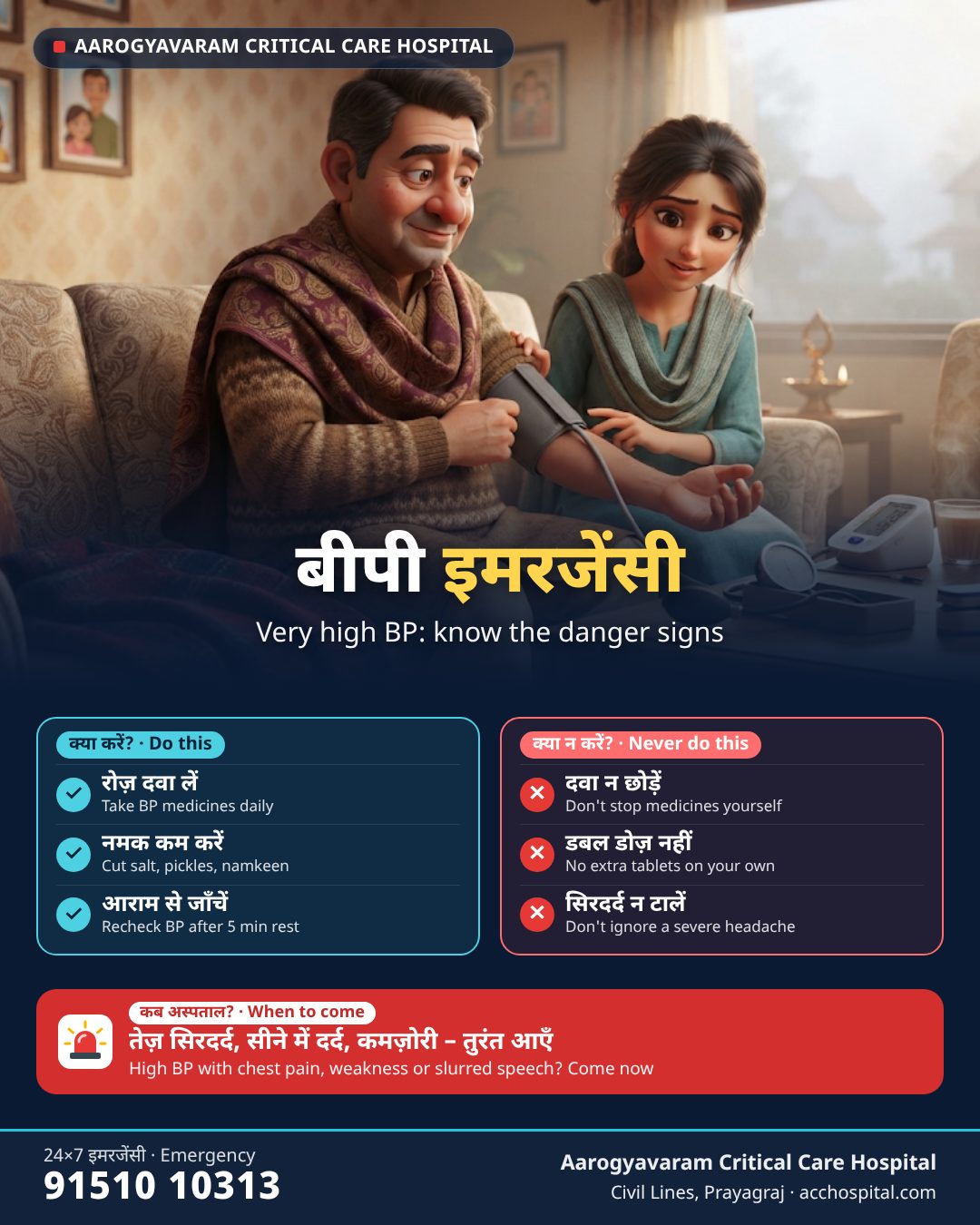
High blood pressure (hypertension, or "high BP") is one of the commonest health problems in Prayagraj, and most people live with it for years without trouble when it is well controlled. But sometimes BP shoots up very high and starts to harm the brain, heart, eyes or kidneys. This is called a hypertensive emergency, and it needs hospital care the same day. Winter makes this more likely: cold mornings narrow the blood vessels, and BP readings often run higher from November to February. The one thing to remember: a very high BP reading together with chest pain, breathlessness, a severe headache, confusion, weakness on one side or trouble speaking means come to the emergency at once.
24×7 Emergency 📞 Call 91510 10313
What is a hypertensive emergency? (High BP emergency kya hai?)
Blood pressure is the force of blood pushing on the walls of the arteries. It is written as two numbers, such as 120/80. When BP climbs to very high levels – often around 180/120 or above – doctors look at whether the body's organs are being affected.
- Hypertensive emergency: very high BP with signs of damage to an organ, for example a stroke, heart attack, fluid in the lungs, sudden kidney problems or bleeding at the back of the eye. This needs urgent hospital treatment.
- Severe high BP without such signs (sometimes called hypertensive urgency): the reading is very high but the person has no warning symptoms. This still needs a doctor's review soon, but BP is usually lowered gradually, not all at once.
Only a doctor can tell the two apart, after examining the person and doing tests. That is why a very high reading should never be handled on guesswork.
Symptoms and warning signs
Many people with high BP feel nothing at all – which is why it is called a "silent" condition. A hypertensive emergency, however, usually announces itself. Watch for:
- A sudden, severe headache, very different from the usual
- Blurred vision or loss of part of the vision
- Chest pain, pressure or tightness
- Breathlessness, especially when lying flat, or frothy cough
- Confusion, unusual drowsiness or behaviour changes
- Sudden weakness or numbness of the face, arm or leg, especially on one side
- Slurred speech, difficulty understanding, or a drooping face
- Fits (seizures)
- Severe back or chest pain that tears through to the back
- Nausea and vomiting with a severe headache
- In pregnancy: headache, blurred vision, swelling of the face or hands, or upper stomach pain
Causes and who is at risk
A BP crisis is most often seen in people who already have high BP. Common triggers include:
- Stopping or skipping BP medicines, or running out of them
- Cold weather, which tightens the blood vessels
- Too much salt – pickles (achar), papad, namkeen, packaged snacks
- Heavy alcohol use or sudden stopping after heavy use
- Severe pain, anxiety or lack of sleep
- Some cold and cough medicines and painkillers taken without advice
- Kidney disease
- Pregnancy-related high BP (pre-eclampsia)
People at higher risk include those over 40, people with diabetes, kidney disease or heart disease, smokers and tobacco users, people who are overweight, and anyone with a family history of high BP or stroke. High BP is also increasingly seen in young adults, so do not assume you are too young.
First aid: what to do at home
- Help the person sit or lie down in a quiet, comfortable place. Keep them calm.
- Recheck the BP after five minutes of rest if you have a home BP machine. Use the correct cuff on the bare upper arm, with the arm resting at heart level.
- Look for warning signs from the list above. If any are present, do not wait – bring the person to the emergency.
- Keep their medicine list and recent reports ready to show the doctor, including the time they last took their BP medicine.
- Do not let them drive themselves. Call for help or have someone else bring them.
- If there are no warning signs but the reading stays very high, contact a doctor the same day for advice. Do not adjust medicines on your own.
What not to do: common mistakes and myths
- Do not give extra tablets or someone else's BP medicine to bring the number down quickly. Lowering BP too fast can itself reduce blood flow to the brain and heart.
- Do not put any tablet under the tongue on your own. This old practice can drop BP suddenly and dangerously.
- Do not stop BP medicines because "the reading is normal now". Normal readings usually mean the medicine is working.
- Do not wait for a severe headache to settle with balms, tea or home remedies.
- Do not rely on garlic, lemon water or any home remedy to control a BP crisis.
- Do not keep checking BP again and again every minute – it causes anxiety and confusing readings. Rest, recheck once, and act on the warning signs.
When to go to the emergency
Come to the emergency at once if high BP comes with any of these:
- Chest pain or pressure
- Breathlessness or frothy cough
- Severe headache, confusion or drowsiness
- Weakness, numbness or drooping on one side, or slurred speech
- Sudden loss of vision
- Fits
- Severe tearing pain in the chest or back
- Very high BP in pregnancy, or headache with blurred vision in pregnancy
For stroke and heart attack, every minute matters. Do not wait to see whether symptoms settle.
How doctors diagnose it
In the emergency, doctors repeat the BP measurement carefully and examine the heart, lungs, eyes and nervous system. Common tests include an ECG for the heart, blood tests for kidney function, salts and heart strain, a urine test, a chest X-ray, and an eye check. If stroke or bleeding in the brain is suspected, a CT or MRI scan of the brain may be done. These tests show whether any organ is being affected and guide treatment.
Treatment options
A hypertensive emergency is usually treated in an emergency room or ICU, where BP can be lowered in a controlled, step-by-step way with close monitoring. The aim is to protect the brain, heart and kidneys, not to bring the number to normal immediately. Doctors also treat whatever organ problem is present – for example a stroke, heart attack or fluid in the lungs – and then work out a long-term medicine plan. People with severe high BP but no warning signs are often managed with adjustment of their regular medicines and close follow-up.
Recovery and care at home
After a BP crisis, the most important step is regular follow-up. Take medicines exactly as prescribed, at the same time every day. Keep a simple BP diary – morning and evening readings for a week before each visit. Report side effects to your doctor instead of stopping medicines yourself. Rest well, return to activity gradually as advised, and keep a written list of your medicines in your wallet or phone.
Prevention
- Take BP medicines every day, even when you feel well, and refill them before they run out.
- Cut down on salt: limit achar, papad, namkeen, chutney powders and packaged snacks.
- Keep warm on cold winter mornings, especially when stepping outside early.
- Walk or exercise regularly as your doctor advises – indoors on heavy smog days.
- Keep a healthy weight, avoid tobacco in any form, and limit alcohol.
- Check BP at home regularly if you have high BP, and get it checked at least once a year if you are over 30.
- Manage diabetes and kidney disease well, and get enough sleep.
Ayushman Bharat and cashless treatment
Aarogyavaram Critical Care Hospital is empanelled under Ayushman Bharat (PMJAY), and many private health insurance policies are accepted for cashless admission, as per the rules of the scheme or policy. Our Ayushman/TPA desk confirms eligibility and handles the paperwork. Please bring your Ayushman card or insurance card and a photo ID.
Frequently asked questions
What BP level is an emergency?
A reading around 180/120 or higher is dangerously high. If it comes with chest pain, breathlessness, severe headache, confusion, weakness or trouble speaking, it is an emergency – come to hospital at once.
BP 180 ho to kya karein?
Mareez ko aaram se bithayein aur 5 minute baad dobara BP check karein. Agar seene mein dard, saans phoolna, tez sir dard, kamzori ya bolne mein dikkat ho to turant emergency aayein. Apne aap extra goli na dein.
Can high BP cause a stroke?
Yes. Very high BP is one of the main causes of stroke and bleeding in the brain. Sudden weakness on one side, a drooping face or slurred speech needs emergency care immediately.
Sardi mein BP kyon badhta hai?
Thand mein khoon ki naliyan sikud jaati hain, jisse BP badh sakta hai. Sardi mein dawa niyamit lein, namak kam karein aur subah ki thand se bachein.
Should I take an extra BP tablet if my reading is high?
No, not without a doctor's advice. Bringing BP down too fast can be harmful. If there are warning signs, come to the emergency; if not, contact your doctor the same day.
Is it safe to put a BP tablet under the tongue?
No. This old practice can drop BP suddenly and dangerously. Only doctors should decide how fast BP is lowered.
High BP mein sir dard ho to kya karein?
Halka sir dard aksar BP se nahi hota, par achanak tez sir dard ke saath dhundhla dikhna, ulti ya kamzori ho to yeh khatre ka sanket hai. Turant hospital aayein.
Can young people get a BP emergency?
Yes. High BP is increasingly seen in people in their 20s and 30s, especially with stress, obesity, tobacco, alcohol or kidney disease. Get your BP checked regularly.
Aarogyavaram Critical Care Hospital, Prayagraj
Aarogyavaram Critical Care Hospital is on T.B. Sapru Marg, Civil Lines, Prayagraj, with a 24×7 emergency and ICU for heart, stroke and BP emergencies. We receive patients from across Prayagraj – Civil Lines, George Town, Katra, Allahpur, Tagore Town, Ashok Nagar, Kareli, Dhoomanganj, Teliyarganj, Rajapur, Mumfordganj, Kydganj, Chowk, Naini, Jhunsi, Phaphamau, Jhalwa, Bamrauli, Subedarganj and Preetam Nagar – and referrals from Kaushambi, Pratapgarh, Bhadohi, Mirzapur, Fatehpur, Chitrakoot, Banda, Jaunpur, Sultanpur, Varanasi, Rewa and Satna. 24×7 Emergency: 91510 10313.
This article is general health information, not medical advice. Diagnosis and treatment are decided by the treating doctor after examination. In an emergency, call 91510 10313 or go to the nearest hospital.