
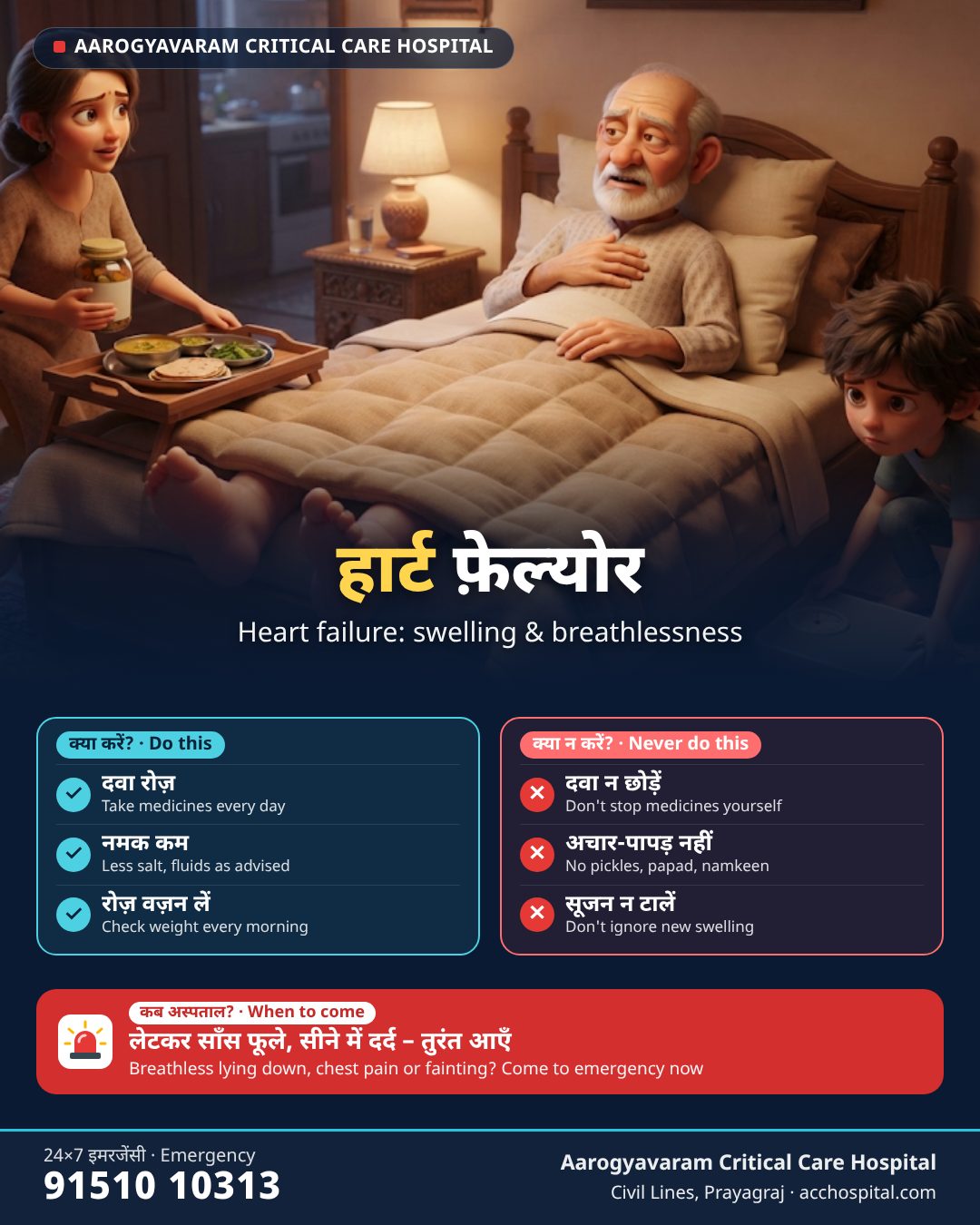
Heart failure does not mean the heart has stopped. It means the heart muscle has become too weak, or too stiff, to pump blood as well as the body needs. Fluid then backs up into the lungs and legs, causing breathlessness and swelling. In Prayagraj winters, cold weather, chest infections and salty winter snacks often tip people with a weak heart into a crisis, and many families mistake the early signs for old age or a cough. The one thing to remember: daily medicines, less salt and a daily weight check keep most people out of hospital – and breathlessness at rest or on lying flat needs the emergency at once.
24×7 Emergency 📞 Call 91510 10313
What is heart failure? (Heart failure ya dil ki kamzori kya hai?)
The heart is a pump. In heart failure, the pump cannot keep up. Doctors often describe two main types:
- Heart failure with reduced pumping (weak heart) – the heart muscle squeezes weakly. Doctors measure this with the ejection fraction (EF) on an echocardiogram.
- Heart failure with preserved pumping (stiff heart) – the heart squeezes normally but is stiff and does not fill well, common in older people with long-standing high BP or diabetes.
Heart failure is usually a long-term (chronic) condition that can be controlled for years with treatment. Acute heart failure is a sudden worsening – fluid fills the lungs and the person becomes very breathless. That is an emergency.
Symptoms and warning signs
- Breathlessness on walking, climbing stairs or doing daily work
- Breathlessness on lying flat, needing two or three pillows to sleep, or waking up at night gasping for breath
- Swelling of the feet, ankles and legs, sometimes the belly
- Sudden weight gain – for example about 2 kg in two or three days – because of fluid, not fat
- Tiredness and weakness, feeling unable to do usual work
- Cough or wheezing, especially at night, sometimes with pink frothy sputum
- Fast or irregular heartbeat (palpitations)
- Less appetite, feeling full quickly, or passing less urine during the day
Swelling and breathlessness can have other causes too, such as kidney, liver or lung disease. A doctor's check-up is needed to find the cause.
Causes and who is at risk
The most common causes are:
- Previous heart attack or blocked heart arteries (coronary artery disease)
- Long-standing high blood pressure
- Diabetes
- Heart valve disease, including rheumatic heart disease
- Heart muscle disease (cardiomyopathy)
- Irregular heartbeat, such as atrial fibrillation
- Severe anaemia and thyroid disease
- Heavy alcohol use
Things that commonly make existing heart failure suddenly worse: missing medicines, too much salt or fluid, chest infections and pneumonia (more common in winter), uncontrolled BP, some painkillers, and a new irregular heartbeat.
First aid: what to do at home
These daily steps help keep heart failure under control:
- Take heart medicines every day, exactly as prescribed, even when you feel well.
- Weigh yourself every morning after passing urine and before breakfast, in similar clothes, and write it down. Tell your doctor if weight rises quickly.
- Limit salt – less salt in cooking, and avoid extra salt at the table, pickles, papad, namkeen and packaged foods.
- Follow your doctor's advice on fluids. Some people are told to limit how much water and other drinks they take.
- Sleep with the head raised if you get breathless on lying flat, and see a doctor soon.
- If breathlessness suddenly becomes severe, sit the person upright with legs down, loosen tight clothing, keep them calm, and bring them straight to a hospital with a 24×7 emergency.
What not to do: common mistakes and myths
- Do not stop or reduce medicines on your own because swelling has gone or you feel better. Feeling better usually means the medicines are working.
- Do not take painkillers without a doctor's advice. Some common painkillers make the body hold salt and water and can worsen heart failure and kidneys.
- Do not eat salty foods freely – pickles, papad, namkeen, chaat and packaged snacks hold a lot of hidden salt.
- Myth: "Swelling of the feet is just old age." New or increasing swelling needs a check-up.
- Myth: "Drinking more water flushes out the swelling." In heart failure, extra fluid can make swelling and breathlessness worse; follow your doctor's fluid advice.
- Do not wait at home with severe breathlessness, hoping it will settle with steam or home remedies.
When to go to the emergency
Come to the emergency at once if there is:
- Breathlessness at rest, or breathlessness that does not let the person lie flat
- Waking up gasping for breath
- Chest pain, pressure or heaviness
- Fainting, severe dizziness or confusion
- A very fast, very slow or irregular heartbeat
- Cough with pink frothy sputum
- Blue or grey lips or fingertips, or cold sweaty skin
- Rapid weight gain with swelling and breathlessness, or very little urine
How doctors diagnose it
- Clinical examination – listening to the lungs and heart, checking swelling and neck veins
- ECG to look at heart rhythm and signs of a past heart attack
- Echocardiogram (echo) – an ultrasound of the heart to check pumping (ejection fraction) and valves
- Chest X-ray to look for fluid in the lungs and heart size
- Blood tests, including NT-proBNP or BNP, kidney function, sodium, potassium, haemoglobin, sugar and thyroid
- Sometimes an angiography to look for blocked heart arteries, if advised
Treatment options
Treatment depends on the type and cause, and is planned by the doctor:
- Medicines that remove extra fluid, lower the strain on the heart and help it work better over time
- Treating the cause – for example opening blocked arteries (angioplasty) when advised, treating valve disease, or controlling an irregular heartbeat
- Controlling BP, diabetes, anaemia and thyroid problems
- In an acute attack: oxygen, medicines through the vein and ICU care, and sometimes breathing support
- Devices such as a pacemaker or ICD for selected patients
Aarogyavaram Critical Care Hospital has a 24×7 emergency, ICU and cardiac care for patients with heart failure and sudden breathlessness.
Recovery and care at home
- Keep a daily diary of weight, BP and pulse if advised, and carry it to follow-ups.
- Take medicines at the same time every day; use a pill box or reminder.
- Stay active with walking as your doctor advises – gentle activity is good for the heart; rest when breathless.
- Keep warm in winter and get the vaccines your doctor recommends, such as flu and pneumonia vaccines.
- Avoid alcohol and stop smoking.
- Know your warning signs and which hospital to reach in an emergency.
Prevention
- Keep BP, sugar and cholesterol under control and take medicines regularly.
- Eat less salt, oil and sweets; keep a healthy weight.
- Walk for about 30 minutes most days, as your doctor allows.
- Stop smoking, gutkha and other tobacco; avoid heavy drinking.
- Do not ignore chest pain, breathlessness or new swelling – early treatment protects the heart.
Ayushman Bharat and cashless treatment
Aarogyavaram Critical Care Hospital is empanelled under Ayushman Bharat (PMJAY). Our Ayushman / TPA desk confirms eligibility and handles the paperwork for cashless treatment with participating insurers.
Frequently asked questions
What are the early signs of heart failure?
Breathlessness on walking or climbing stairs, swelling of the feet and ankles, tiredness, and needing extra pillows to breathe at night are common early signs. Sudden weight gain over a few days can also be a warning.
Heart failure ke lakshan kya hain?
Chalne par saans phoolna, letne par ya raat mein saans phoolna, pairon mein sujan, thakan aur kuch dinon mein achanak vazan badhna – ye heart failure ke lakshan ho sakte hain. Aise lakshan ho to doctor ko zaroor dikhayein.
Is heart failure the same as a heart attack?
No. A heart attack is a sudden blockage of a heart artery. Heart failure is a condition in which the heart cannot pump well; a past heart attack is one of its common causes.
Pairon mein sujan kyon aati hai?
Pairon mein sujan dil, kidney ya liver ki bimari, nason ki samasya ya kuch dawaon se ho sakti hai. Agar sujan ke saath saans bhi phoole, to yeh heart failure ka sanket ho sakta hai – jaanch zaroor karayein.
Can heart failure be treated?
Yes. Many people with heart failure live active lives for years with regular medicines, less salt, daily weight checks and treatment of the cause. Treatment controls symptoms and lowers the chance of hospital admissions.
How much water should a heart failure patient drink?
It depends on the person. Some patients are asked to limit fluids, others are not. Follow the amount your doctor advises, and ask again if your medicines change.
Letne par saans kyon phoolti hai?
Kamzor dil ke kaaran phephdon mein paani jama hone lagta hai, jo letne par aur badh jata hai. Agar takiye badhane pade ya raat mein saans phool kar neend khule, to jaldi doctor ko dikhayein; aaraam mein bhi saans phoole to turant emergency aayein.
Why does heart failure get worse in winter?
Cold weather raises blood pressure and puts strain on the heart, chest infections are more common, and people often eat saltier food. Keep warm, take medicines regularly and get the vaccines your doctor advises.
Where can I get heart failure treatment in Prayagraj?
Aarogyavaram Critical Care Hospital in Civil Lines, Prayagraj, has a 24×7 emergency, ICU and cardiac care for heart failure and sudden breathlessness.
Aarogyavaram Critical Care Hospital, Prayagraj
Aarogyavaram Critical Care Hospital is at Civil Lines, Prayagraj, with a 24×7 emergency and ICU. Families from across Prayagraj – including Civil Lines, George Town, Katra, Naini, Jhunsi, Phaphamau and nearby areas – can reach us at any hour. Emergency number: 91510 10313.
This article is general health information, not medical advice. Diagnosis and treatment are decided by the treating doctor after examination. In an emergency, call 91510 10313 or go to the nearest hospital.