
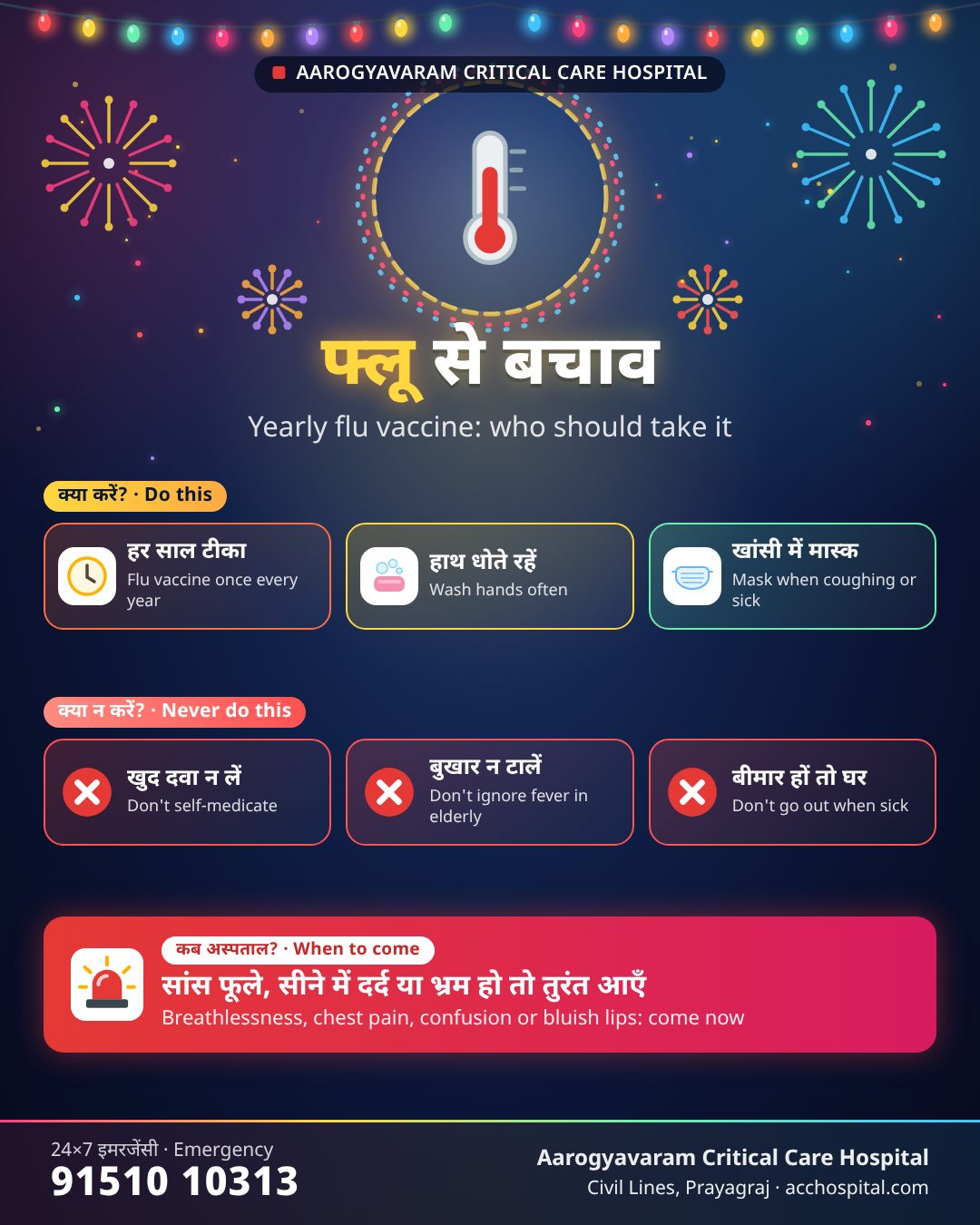
Flu, or influenza, is a viral infection of the nose, throat and lungs that spreads quickly when the weather turns cold. In Prayagraj, flu cases usually rise from November through the winter, when families stay indoors together, crowds gather at festivals and weddings, and the air quality drops. For most healthy adults flu passes in a week, but for elderly people, young children, pregnant women and people with diabetes, heart, lung or kidney disease, it can turn into pneumonia and need hospital or ICU care. The one thing to remember: a flu vaccine once every year, taken on your doctor's advice, is one of the simplest ways to lower this risk.
24×7 Emergency 📞 Call 91510 10313
What is flu? (Flu kya hai?)
Influenza is caused by influenza viruses that spread through droplets when an infected person coughs, sneezes or talks, and through hands that touch contaminated surfaces and then the face. It is different from the common cold. A cold usually causes a runny nose and mild discomfort; flu tends to come on suddenly with high fever, body ache and marked tiredness. In Hindi it is commonly called फ्लू, इन्फ्लुएंज़ा or मौसमी बुखार-ज़ुकाम.
The flu virus changes a little every year. That is why the vaccine is updated every year and why last year's dose does not fully protect you this year.
Symptoms and warning signs
Common flu symptoms are:
- Sudden fever, often high, with chills
- Body ache, headache and severe tiredness
- Dry cough and sore throat
- Runny or blocked nose
- Loss of appetite; sometimes vomiting or loose motions, especially in children
Warning signs that flu is becoming serious:
- Difficulty in breathing, fast breathing or breathlessness at rest
- Chest pain or pressure
- Bluish lips or face, or low oxygen on a pulse oximeter
- Confusion, unusual drowsiness or difficulty waking up
- Fever that keeps coming back or does not come down
- In children: fast breathing, chest indrawing, not drinking, not passing urine, very sleepy or a fit (seizure)
- Worsening of an existing illness such as asthma, COPD, diabetes or heart disease
Causes and who is at risk
Anyone can catch flu, but complications are more likely in:
- People aged 65 and above
- Children below 5 years, especially below 2
- Pregnant women
- People with diabetes, heart disease, asthma or COPD, kidney or liver disease
- People with weak immunity – for example on cancer treatment, long-term steroids or after a transplant
- People with severe obesity
- Healthcare workers and people who care for the elderly or infants
First aid: what to do at home
If someone at home has flu-like illness:
- Rest at home and avoid work, school and crowded places until the fever has settled.
- Drink plenty of fluids – water, soups, ORS, dal water – to avoid dehydration.
- Check temperature regularly; for elderly people and those with lung disease, check oxygen with a pulse oximeter if you have one.
- Use fever medicine only as advised by your doctor or as on your existing prescription.
- Cover coughs and sneezes with a tissue or elbow, wash hands often, and wear a mask around elders, infants and pregnant women.
- Keep the sick person in a well-ventilated room and use separate towels and utensils.
- If the person is elderly, pregnant, a young child or has a chronic illness, speak to a doctor early rather than waiting.
What not to do: common mistakes and myths
- Do not take antibiotics on your own for a viral fever. Antibiotics do not work on the flu virus and misuse leads to resistance.
- Do not mix several cold and fever medicines from the chemist without advice.
- Do not keep going to work or crowded places while sick – you spread it to others.
- Do not ignore breathlessness in an elderly person, assuming it is "just weakness".
- Myth: "The flu vaccine gives you flu." The injected vaccine does not contain live virus that can cause flu; a mild sore arm or slight fever for a day can happen.
- Myth: "I took the vaccine last year, so I'm covered." Protection fades and the virus changes, so it is needed every year.
- Myth: "Flu is just a bad cold." For high-risk people, flu can lead to pneumonia and hospital admission.
When to go to the emergency
Come to the emergency at once if there is:
- Difficulty breathing, fast breathing or breathlessness at rest
- Chest pain or pressure
- Bluish lips or low oxygen reading
- Confusion, severe drowsiness or a fit
- High fever that does not come down, or comes back after improving
- A child who is very sleepy, not drinking or not passing urine
- Sudden worsening of diabetes, asthma, COPD or heart disease during the illness
How doctors diagnose it
Doctors usually diagnose flu from the symptoms, the season and an examination. In some patients a nose or throat swab test for influenza is done. If there are warning signs, doctors may check oxygen levels, do blood tests, a chest X-ray to look for pneumonia, and tests for sugar, kidney function and other illnesses with similar symptoms such as dengue, malaria or typhoid, which are also common in Prayagraj at this time of year.
Treatment options
Most people with flu recover with rest, fluids and fever control. In high-risk or seriously ill patients, doctors may prescribe antiviral treatment, which works best when started early. Patients with pneumonia, low oxygen or worsening chronic illness may need hospital admission for oxygen, intravenous fluids and close monitoring, and some need ICU care or breathing support. The treating doctor decides what is needed for each patient.
Recovery and care at home
After flu, tiredness and a cough can last a week or two. Return to work slowly. Keep eating well and drinking fluids. Elderly people and those with chronic illness should keep checking their sugar, blood pressure and breathing during recovery. Return to the hospital if fever comes back, breathlessness appears or the cough gets worse instead of better.
Prevention
- Ask your doctor about the flu vaccine once every year, ideally before the peak winter months – especially for elders, people with chronic illness, pregnant women and young children
- Wash hands often with soap and water
- Cover coughs and sneezes; wear a mask when you are unwell or in crowded places during flu season
- Stay home when sick
- Keep diabetes, asthma, COPD and heart disease well controlled
- Keep elders warm, well fed and well rested through the winter
- Ask your doctor whether a pneumonia vaccine is also advised for you
Ayushman Bharat and cashless treatment
If flu or pneumonia leads to hospital admission, Aarogyavaram Critical Care Hospital is empanelled under Ayushman Bharat (PMJAY) and the Pt. Deen Dayal Upadhyay state employee scheme, and offers cashless treatment with many insurers and TPAs. Bring the Ayushman card or insurance card and Aadhaar at admission; our desk will guide the family.
Frequently asked questions
1. flu vaccine kab lagwana chahiye?
Flu ka teeka har saal lagwana hota hai, behtar hai ki sardi ke peak se pehle. Sahi samay aur aapke liye zaroorat ke baare mein apne doctor se poochein.
2. who should take flu vaccine every year?
It is especially advised for people aged 65 and above, young children, pregnant women, people with diabetes, heart, lung or kidney disease, and healthcare workers. Your doctor will advise whether it is right for you.
3. flu aur normal sardi-zukaam mein kya farak hai?
Sardi-zukaam mein aam taur par naak behti hai aur halki takleef hoti hai. Flu achanak tez bukhar, badan dard aur bahut thakan ke saath aata hai, aur high-risk logon mein pneumonia ban sakta hai.
4. can flu vaccine cause flu?
No. The injected flu vaccine cannot give you flu. Some people get a sore arm or a mild fever for a day, which settles on its own.
5. kya flu mein antibiotic leni chahiye?
Nahi, flu virus se hota hai aur antibiotic virus par kaam nahi karti. Doctor ki salah ke bina antibiotic na lein; zaroorat ho to doctor hi decide karenge.
6. is flu vaccine safe in pregnancy?
Health authorities recommend the flu vaccine for pregnant women because flu can be more serious in pregnancy. Discuss it with your obstetrician.
7. buzurgon mein flu khatarnak kab hota hai?
Jab saans phoole, seene mein dard ho, honth neele padein, bhram (confusion) ho ya bukhar na utre. Aise mein turant emergency le jaayein.
8. flu kitne din mein theek hota hai?
Zyaadatar log 5–7 din mein theek ho jaate hain, par khaansi aur thakan 1–2 hafte reh sakti hai. Bukhar dobara aaye ya saans phoole to doctor ko dikhayein.
9. flu with breathing problem hospital in Prayagraj?
Aarogyavaram Critical Care Hospital on T.B. Sapru Marg, Civil Lines, runs a 24×7 emergency and ICU. Call 91510 10313 on the way.
Aarogyavaram Critical Care Hospital, Prayagraj
Aarogyavaram Critical Care Hospital is on T.B. Sapru Marg, Civil Lines, Prayagraj, with a 24×7 emergency and ICU. We receive patients from across Prayagraj – Civil Lines, George Town, Katra, Allahpur, Tagore Town, Ashok Nagar, Kareli, Dhoomanganj, Teliyarganj, Rajapur, Mumfordganj, Kydganj, Chowk, Naini, Jhunsi, Phaphamau, Jhalwa, Bamrauli, Subedarganj and Preetam Nagar – and referrals from Kaushambi, Pratapgarh, Bhadohi, Mirzapur, Fatehpur, Chitrakoot, Banda, Jaunpur, Sultanpur, Varanasi, Rewa and Satna. 24×7 Emergency: 91510 10313.
This article is general health information, not medical advice. Diagnosis and treatment are decided by the treating doctor after examination. In an emergency, call 91510 10313 or go to the nearest hospital.