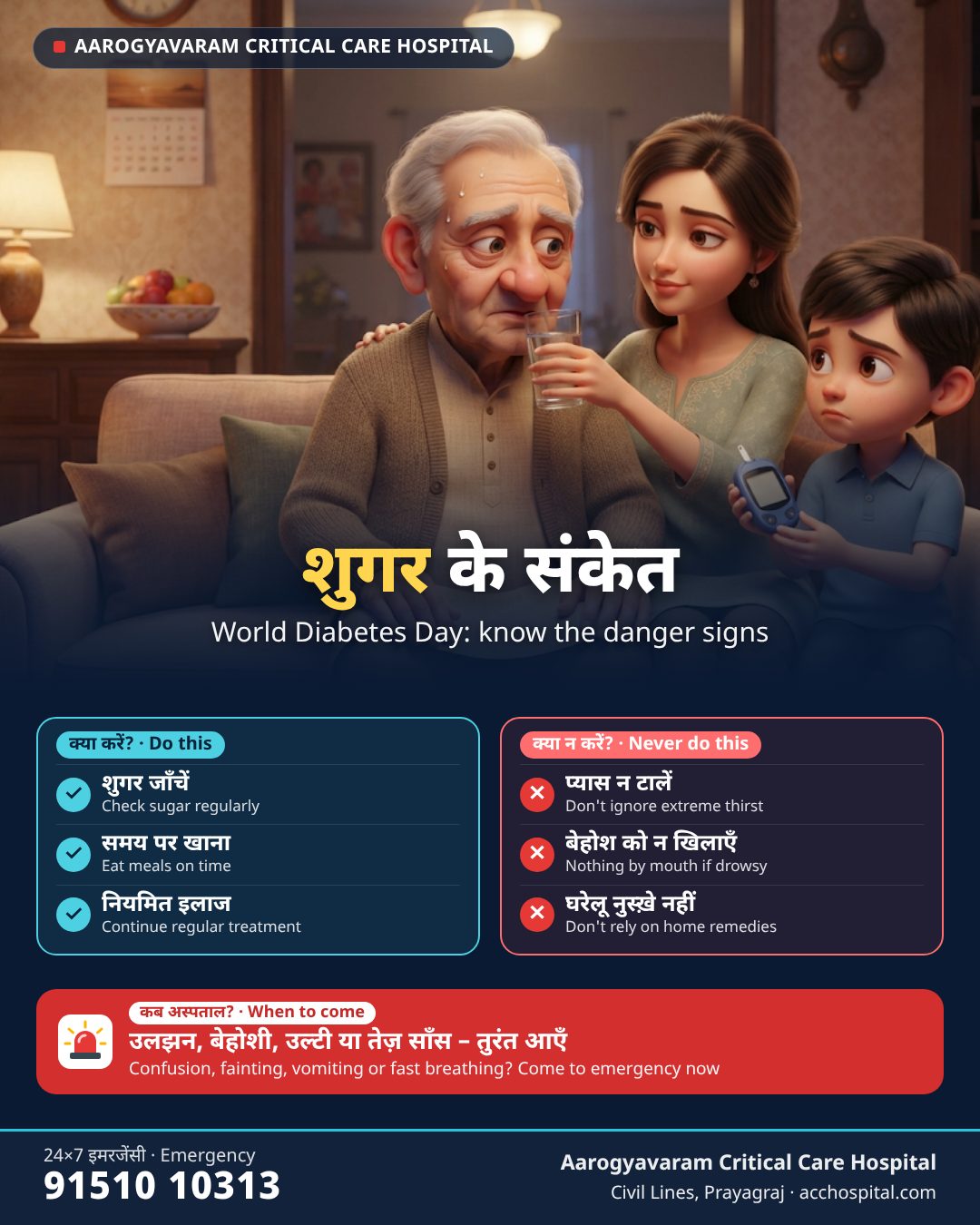
World Diabetes Day falls on 14 November. Diabetes (sugar ki bimari, madhumeh) is now common in almost every family in Prayagraj – in elders, in young working adults and sometimes even in children. On most days it is managed quietly at home with diet, activity and regular treatment. But blood sugar that climbs very high, or falls very low, can turn into a real emergency within hours. Knowing the warning signs helps families act early. The one thing to remember: confusion, fainting, repeated vomiting or difficult breathing in a person with diabetes means come to the emergency at once.
24×7 Emergency 📞 Call 91510 10313
What is a diabetes emergency? (Sugar emergency kya hai?)
Diabetes means the body cannot keep blood sugar in the normal range on its own. Two kinds of emergency can happen:
- Very low sugar (hypoglycaemia, sugar kam hona): sugar drops too low, often suddenly. The brain needs sugar to work, so the person can become confused, faint or have a fit. This can happen within minutes.
- Very high sugar: sugar stays very high for hours or days. In some people, especially those with type 1 diabetes (including children), the body starts making acids called ketones – this is called diabetic ketoacidosis (DKA). In older people with type 2 diabetes, very high sugar can cause severe dehydration and drowsiness. Both are serious and need hospital care.
Symptoms and warning signs
Signs of very low sugar:
- Sweating, shaking, cold clammy skin
- Pounding or racing heart
- Sudden strong hunger, anxiety or irritability
- Blurred vision, headache, weakness
- Confusion, odd behaviour, slurred speech
- Fainting or a seizure (fit)
Signs of very high sugar:
- Extreme thirst and dry mouth
- Passing urine again and again
- Tiredness, weakness, weight loss
- Nausea, vomiting, stomach pain
- Fast, deep breathing; a fruity smell on the breath
- Confusion, drowsiness or unconsciousness
In children, new diabetes often first shows up as extreme thirst, frequent urination, bed-wetting in a child who was dry, weight loss and tiredness. On Children's Day it is worth remembering: a child with these signs who then starts vomiting or breathing fast needs hospital care the same day.
Causes and who is at risk
Low sugar is most common in people taking diabetes tablets or injections who:
- Skip or delay a meal, or eat much less than usual
- Do more physical work or exercise than usual
- Take an extra or wrong dose by mistake
- Drink alcohol, especially on an empty stomach
- Have kidney problems or are elderly
Very high sugar is more likely during:
- An infection – fever, urine infection, pneumonia, a foot wound
- Stopping or missing regular treatment
- Heavy festival and wedding-season eating
- Serious illness such as a heart attack or stroke
- Undiagnosed diabetes, especially in children and young adults
First aid: what to do at home
- Check the sugar with a home glucometer if one is available. Note the reading and the time.
- If sugar is low and the person is fully awake and can swallow: give something sweet at once – a glass of sweetened water, fruit juice, or a few spoons of sugar or glucose.
- Recheck after about 15 minutes. If it is still low or the person is not better, give something sweet again and arrange to come to hospital.
- Once better, give a proper snack or meal so the sugar does not drop again.
- If the person is drowsy, confused or unconscious: do not put anything in the mouth. Lay them on their side, keep the airway clear, and come to the emergency straight away.
- If sugar is very high and the person is unwell – vomiting, breathless, very thirsty or drowsy – come to hospital. Give small sips of water only if fully awake.
- Bring the treatment list and the glucometer readings with you.
What not to do: common mistakes and myths
- Do not give food, water or sugar by mouth to someone who is drowsy or unconscious – it can go into the lungs.
- Do not stop regular diabetes treatment on your own when unwell. Many people need treatment changes during illness, but only on a doctor's advice.
- Do not depend on karela juice, jamun seeds, methi or other home remedies during an emergency. They cannot correct a dangerously high or low sugar.
- Do not assume shaking and sweating are "just weakness" – check the sugar.
- Do not wait overnight with vomiting and very high sugar, especially in a child.
- Do not let the person drive themselves to hospital.
When to go to the emergency
Come to the emergency at once if a person with diabetes has:
- Confusion, unusual drowsiness or unconsciousness
- Fainting or a seizure
- Low sugar that does not improve after giving something sweet
- Repeated vomiting or stomach pain
- Fast, deep or difficult breathing, or a fruity smell on the breath
- Very high readings with fever, infection or not eating
- Chest pain, weakness of one side of the body or slurred speech
How doctors diagnose it
In the emergency, the team checks blood sugar at once with a finger-prick test. Blood tests check sugar, ketones, the acid level of the blood, salts like sodium and potassium, and kidney function. A urine test, ECG and tests for infection may also be done, because an infection or heart problem is often the trigger.
Treatment options
Low sugar is corrected quickly with glucose given by mouth or through a vein, and the cause is looked for. DKA and very high sugar need hospital treatment with fluids through a vein, carefully adjusted treatment to bring sugar down slowly, correction of salts, and close monitoring – often in the ICU. Any infection or other trigger is treated at the same time. Before going home, the team reviews the diabetes plan with the family.
Recovery and care at home
After a sugar emergency, follow the discharge advice closely. Check sugar more often for a few days, eat regular meals, and keep all follow-up visits. Learn the signs of low and high sugar as a family, keep a sweet drink handy, and keep the glucometer working. For children, the school should know the warning signs too.
Prevention
- Check sugar regularly as advised, and more often when unwell
- Eat meals on time; do not skip meals
- Stay active – a daily walk helps
- Do not stop or change treatment without medical advice
- Keep festive sweets and heavy meals in small portions
- Get a yearly eye, kidney and foot check-up
- Know your numbers – including the three-month sugar test (HbA1c)
Ayushman Bharat and cashless treatment
Aarogyavaram Critical Care Hospital is empanelled under Ayushman Bharat (PMJAY), and many private health insurance policies are accepted for cashless admission, as per the rules of the scheme or policy. Our Ayushman/TPA desk confirms eligibility and handles the paperwork. Please bring your Ayushman card or insurance card and a photo ID.
Frequently asked questions
What are the signs of low sugar in diabetes?
Sweating, shaking, a pounding heart, sudden hunger, confusion and sometimes fainting. If the person is awake, give something sweet and check the sugar again.
Sugar kam ho jaye to kya karein?
Agar vyakti hosh mein hai aur nigal sakta hai, to turant meetha paani, juice ya cheeni dein. 15 minute baad sugar dobara check karein; theek na ho to hospital aayein.
Sugar bahut badh jaye to kya khatra hai?
Bahut zyada sugar se pyaas, baar-baar peshab, ulti, tez saans aur behoshi ho sakti hai. Yeh DKA ho sakta hai, jiske liye hospital mein ilaj zaroori hai.
What is DKA in diabetes?
Diabetic ketoacidosis is a serious condition where very high sugar makes the body produce acids. Signs include vomiting, stomach pain, fast breathing and a fruity breath smell. It needs emergency treatment.
Can children get diabetes?
Yes. Watch for extreme thirst, frequent urination, bed-wetting, weight loss and tiredness. A child with these signs who starts vomiting or breathing fast should be brought to hospital the same day.
Behosh vyakti ko cheeni de sakte hain?
Nahin. Behosh ya bahut sust vyakti ke munh mein kuch na daalein. Unhein karvat par litayein aur turant emergency aayein.
Should I stop diabetes medicine when I have fever?
Do not stop or change treatment on your own. Illness often raises sugar. Check sugar more often and ask your doctor what to do.
Karela juice se sugar control ho jaati hai kya?
Home remedies cannot replace treatment, and they cannot fix a sugar emergency. Follow your doctor's advice and keep checking sugar.
Aarogyavaram Critical Care Hospital, Prayagraj
Aarogyavaram Critical Care Hospital is on T.B. Sapru Marg, Civil Lines, Prayagraj, with a 24×7 emergency and ICU, and care for diabetes emergencies, infections and heart problems. We receive patients from across Prayagraj – Civil Lines, George Town, Katra, Allahpur, Tagore Town, Ashok Nagar, Kareli, Dhoomanganj, Teliyarganj, Rajapur, Mumfordganj, Kydganj, Chowk, Naini, Jhunsi, Phaphamau, Jhalwa, Bamrauli, Subedarganj and Preetam Nagar – and referrals from Kaushambi, Pratapgarh, Bhadohi, Mirzapur, Fatehpur, Chitrakoot, Banda, Jaunpur, Sultanpur, Varanasi, Rewa and Satna. 24×7 Emergency: 91510 10313.
This article is general health information, not medical advice. Diagnosis and treatment are decided by the treating doctor after examination. In an emergency, call 91510 10313 or go to the nearest hospital.