
Every dengue season in Prayagraj, families worry most about one thing: the platelet count. Reports are checked again and again, while the real danger signs are sometimes missed. Dengue is a viral fever spread by the Aedes mosquito, and most people recover fully with rest, fluids and timely medical follow-up. A small number develop severe dengue, which can become life-threatening, usually around the time the fever comes down. The one thing to remember: watch for warning signs, not just the platelet number, and come to the emergency at once if they appear.
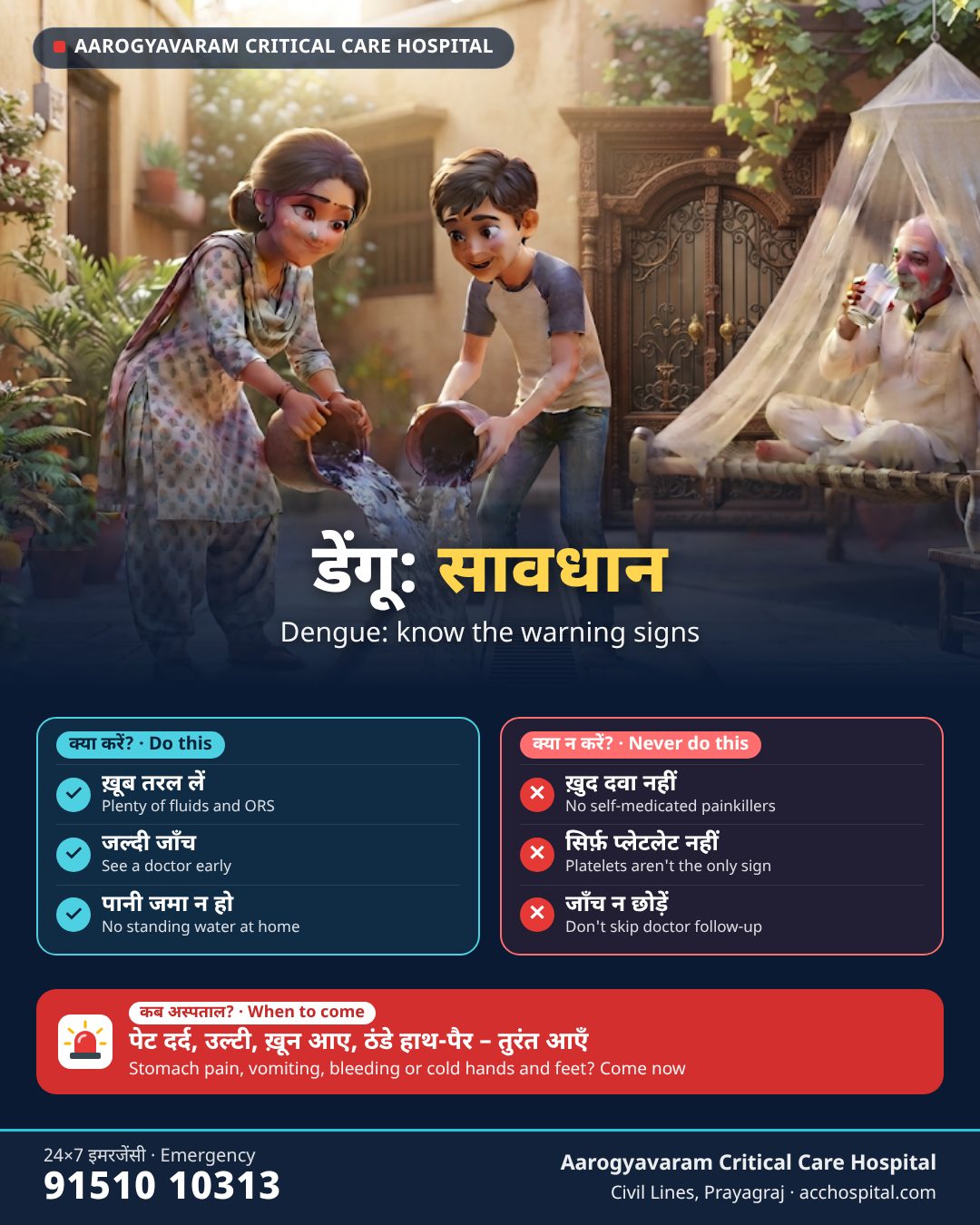
24×7 Emergency 📞 Call 91510 10313
What is dengue? (Dengue kya hai?)
Dengue is an infection caused by the dengue virus. It spreads when an infected Aedes mosquito bites – a mosquito that breeds in clean standing water and bites mostly during the day. In Prayagraj, cases usually rise after the monsoon and continue into November until the weather turns properly cold.
Dengue usually passes through three phases:
- Fever phase (first 2–7 days): high fever, body ache, headache, pain behind the eyes, sometimes a rash.
- Critical phase (around the time fever comes down, often day 3–7): in a few people, fluid leaks out of the blood vessels. This is when severe dengue, shock and bleeding can develop.
- Recovery phase: appetite returns, the person feels better, and platelets rise on their own.
Symptoms and warning signs
Common dengue symptoms:
- Sudden high fever
- Severe body ache and joint pain
- Headache and pain behind the eyes
- Nausea, loss of appetite, tiredness
- Skin rash, sometimes appearing a few days in
Warning signs of severe dengue:
- Severe or continuous stomach pain
- Vomiting again and again, or unable to keep fluids down
- Bleeding from the gums or nose, blood in vomit, or black stools
- Cold, clammy hands and feet
- Passing very little urine
- Extreme weakness, restlessness, drowsiness or confusion
- Breathlessness
- In children: unusual sleepiness, not drinking, or no urine for many hours
These signs often appear just as the fever settles, when families feel the worst is over. Stay alert for two to three days after the fever comes down.
Causes and who is at risk
Dengue is caused only by the bite of an infected mosquito – it does not spread by touch, food or air. Anyone can get it. People more likely to become seriously ill include infants and young children, pregnant women, elderly people, people with diabetes, high BP, heart, kidney or liver disease, people who are very overweight, and people who have had dengue before (a second infection can sometimes be more severe).
First aid: what to do at home
- See a doctor early for any high fever during the dengue season, and get the tests the doctor advises.
- Drink plenty of fluids – water, ORS, coconut water, soups, dal water, lassi or fresh juices – little and often.
- Rest well. Do not go to work, school or the gym while feverish.
- For fever, use only the medicine your doctor advises, and sponge with lukewarm water.
- Keep track of how much the person drinks and how often they pass urine.
- Use a mosquito net even during the day, so that mosquitoes do not bite the sick person and spread it to others at home.
- Watch for warning signs and come to the emergency at once if any appear.
What not to do: common mistakes and myths
- Mistake: skipping the doctor and managing only at home. Diet, fluids and home care help recovery, but they do not replace regular check-ups and blood tests advised by your doctor during the critical days.
- Mistake: stopping fluids when the fever goes. The critical phase often starts as the fever settles. Keep drinking fluids and keep watching for warning signs for two to three more days.
- Myth: only the platelet count matters. Dangerous dengue is mainly about fluid leaking from the blood vessels. A person can be in danger with a "not very low" count, and many people with low platelets recover well with careful monitoring. Doctors look at the whole picture – symptoms, blood pressure, pulse, haematocrit and urine output.
- Myth: every dengue patient needs a platelet transfusion. Most do not. Transfusion is given only when doctors judge it necessary, for example with significant bleeding.
- Do not take painkillers or injections on your own. Some common painkillers can increase the risk of bleeding in dengue.
- Do not take antibiotics or steroids without a doctor's advice – they do not treat a viral infection like dengue.
- Do not ignore a fever that has come down if the person still looks unwell.
When to go to the emergency
Come to the emergency at once if there is:
- Severe stomach pain or repeated vomiting
- Any bleeding – gums, nose, vomit, urine or black stools
- Cold, clammy hands and feet, or a weak, fast pulse
- Very little urine for six hours or more
- Extreme weakness, restlessness, drowsiness or fainting
- Breathlessness
- A child who is unusually sleepy, irritable or not drinking
Do not wait for a platelet report if any of these signs are present.
How doctors diagnose it
Doctors examine the patient and check blood pressure, pulse and hydration. Common tests include a dengue NS1 antigen test (useful in the first few days), dengue antibody tests (IgM/IgG, usually after day 4–5), and a complete blood count to check platelets, white cells and haematocrit (how concentrated the blood is). Liver and kidney tests and an ultrasound may be done if severe dengue is suspected. Repeat tests help doctors follow the illness day by day.
Treatment options
There is no specific medicine that kills the dengue virus. Treatment means supporting the body while the illness runs its course: fluids by mouth or through a drip, fever control with safe medicine, close monitoring of blood pressure, pulse, urine and blood counts, and treatment of complications. People with warning signs or severe dengue are admitted, and some need ICU care for shock, bleeding or organ problems. Platelet or other blood products are given only when doctors judge them necessary.
Recovery and care at home
Recovery can bring tiredness and weakness for a week or two. Eat light, home-cooked food, keep drinking fluids, and return to work and exercise gradually. Attend follow-up visits and get blood counts rechecked if your doctor advises. A rash and itching during recovery are common and usually settle on their own.
Prevention
- Empty and scrub coolers, buckets, pots, flower vases, old tyres and pet bowls at least once a week.
- Cover water tanks and stored water tightly.
- Wear full-sleeved clothes and use mosquito repellent, especially in the early morning and late afternoon.
- Use mosquito nets for children, the elderly and anyone who is sick, even during daytime naps.
- Put mesh on windows and doors where possible.
- Ask neighbours to clear standing water too – dengue prevention works well when a whole mohalla takes part.
Ayushman Bharat and cashless treatment
Aarogyavaram Critical Care Hospital is empanelled under Ayushman Bharat (PMJAY), and many private health insurance policies are accepted for cashless admission, as per the rules of the scheme or policy. Our Ayushman/TPA desk confirms eligibility and handles the paperwork. Please bring your Ayushman card or insurance card and a photo ID.
Frequently asked questions
What are the warning signs of dengue?
Severe stomach pain, repeated vomiting, bleeding from the gums or nose, black stools, cold and clammy hands and feet, very little urine, extreme weakness or drowsiness. Any of these needs emergency care at once.
Dengue mein platelet kitna hone par hospital jaana chahiye?
Sirf platelet number se faisla na karein. Pet dard, baar-baar ulti, khoon aana, thande haath-pair ya bahut kamzori ho to platelet kitna bhi ho, turant emergency aayein. Doctor ki salah se jaanch karwate rahein.
What platelet count is dangerous in dengue?
There is no single number that decides danger. Doctors look at warning signs, blood pressure, pulse, hydration and haematocrit along with platelets. Bleeding or warning signs need emergency care whatever the count.
Dengue mein bukhar utarne ke baad bhi khatra hota hai kya?
Haan. Dengue ka sabse khatarnak samay aksar bukhar utarne ke aas-paas hota hai. Pet dard, baar-baar ulti, khoon aana ya thande haath-pair hon to turant emergency aayein.
Which painkiller is safe in dengue?
Take only the fever medicine your doctor advises. Some common painkillers can increase the risk of bleeding in dengue, so do not take any painkiller or injection on your own.
Does every dengue patient need a platelet transfusion?
No. Most people recover without a transfusion. Doctors give platelets only when they judge it necessary, such as with significant bleeding.
Dengue mein kya khana chahiye?
Halka ghar ka khana, dal ka paani, soup, nariyal paani, ORS aur taaze juice thoda-thoda karke lete rahein. Tala-bhuna aur bahut masaledar khana na lein.
How do I know if dengue is getting serious?
Watch for severe stomach pain, repeated vomiting, bleeding, black stools, cold hands and feet, very little urine, extreme weakness or drowsiness. Any of these means come to the emergency at once.
Aarogyavaram Critical Care Hospital, Prayagraj
Aarogyavaram Critical Care Hospital is on T.B. Sapru Marg, Civil Lines, Prayagraj, with a 24×7 emergency and ICU for fever emergencies, severe dengue and other critical illnesses. We receive patients from across Prayagraj – Civil Lines, George Town, Katra, Allahpur, Tagore Town, Ashok Nagar, Kareli, Dhoomanganj, Teliyarganj, Rajapur, Mumfordganj, Kydganj, Chowk, Naini, Jhunsi, Phaphamau, Jhalwa, Bamrauli, Subedarganj and Preetam Nagar – and referrals from Kaushambi, Pratapgarh, Bhadohi, Mirzapur, Fatehpur, Chitrakoot, Banda, Jaunpur, Sultanpur, Varanasi, Rewa and Satna. 24×7 Emergency: 91510 10313.
This article is general health information, not medical advice. Diagnosis and treatment are decided by the treating doctor after examination. In an emergency, call 91510 10313 or go to the nearest hospital.