
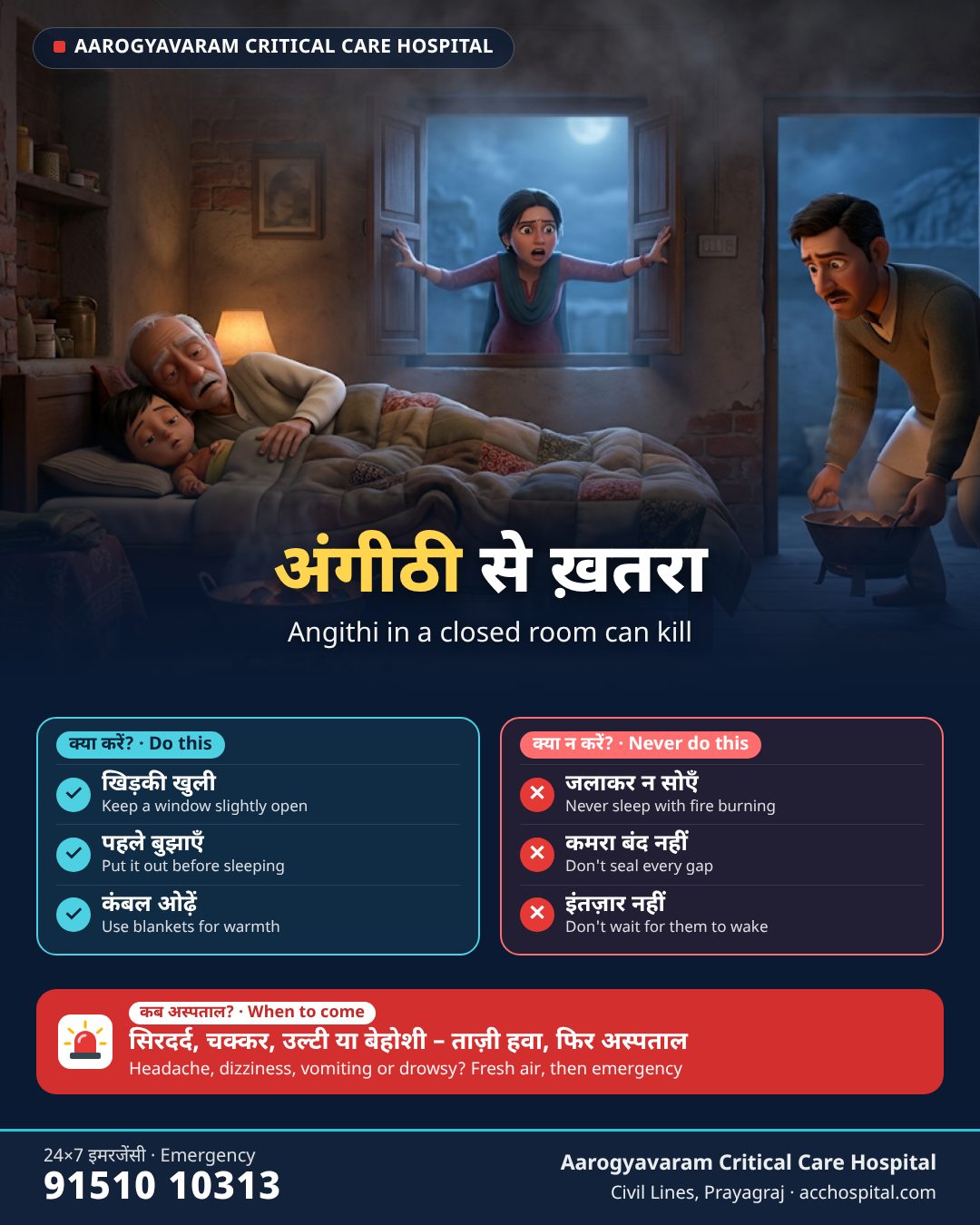
Every winter in Prayagraj, many families keep an angithi, a coal or wood fire, a kerosene stove or a gas heater burning in a closed room to stay warm at night. These fires give off carbon monoxide (CO), a gas with no colour, no smell and no taste. In a room with doors and windows shut, it builds up quietly and can make people unconscious in their sleep – sometimes a whole family at once. The one thing to remember: never sleep with any fire burning in a closed room, and if people feel headache, dizziness or vomiting near a fire, get everyone into fresh air at once.
24×7 Emergency 📞 Call 91510 10313
What is carbon monoxide poisoning? (Carbon monoxide poisoning kya hai?)
When coal, wood, charcoal, kerosene, gas or petrol burns without enough fresh air, it produces carbon monoxide. When we breathe it in, it sticks to the blood much more strongly than oxygen does. The blood then cannot carry enough oxygen to the brain, heart and other organs.
Because the gas cannot be seen or smelled, people often do not realise anything is wrong. Sleeping people may not wake up at all. Smoke and smell from an angithi are not a reliable warning – a fire that looks like it has died down and is only glowing can still give off a lot of carbon monoxide.
Symptoms and warning signs
Early symptoms are easy to mistake for tiredness, a cold or food poisoning:
- Headache, often dull and throbbing
- Dizziness and weakness
- Nausea and vomiting
- Feeling sleepy, confused or "not like yourself"
- Breathlessness or chest discomfort
- Blurred vision
Strong clues that it is carbon monoxide:
- Several people, or pets, in the same room feel unwell at the same time
- Symptoms start or get worse at night or in the room with the fire
- Symptoms improve after going outside into fresh air
Signs of serious poisoning:
- Unconsciousness or being very hard to wake
- Confusion, unusual behaviour or slurred speech
- Fits (seizures)
- Chest pain or a fast, irregular heartbeat
- Severe breathlessness
- Collapse
Causes and who is at risk
Carbon monoxide builds up when a fire or engine burns in a space with poor ventilation:
- An angithi, sigri, coal or wood fire kept in a closed bedroom overnight
- Kerosene stoves or lamps used in small rooms
- Gas heaters or gas geysers in closed bathrooms or rooms without an outlet
- Generators or vehicles running in closed garages, shops or near windows
- Blocked chimneys or flues
People at higher risk of serious harm include:
- Babies and young children
- Pregnant women (the unborn baby is especially sensitive)
- Elderly people
- People with heart disease, lung disease (such as asthma or COPD) or anaemia
- Anyone who is asleep or has had alcohol, as they may not notice the warning signs
First aid: what to do at home
- Open doors and windows at once to let fresh air in.
- Put out the fire if it is safe to do so, or move it outside. Do not stay in the room longer than needed.
- Take everyone out into fresh air, including people who seem fine.
- If a person is drowsy or unconscious but breathing, lay them on their side (recovery position) so they do not choke if they vomit.
- If a person is not breathing, start CPR if you know how, and call for help.
- Keep the person warm with blankets once in fresh air.
- Reach a hospital quickly, even if the person seems to be improving.
What not to do: common mistakes and myths
- Do not sleep with an angithi, coal fire, kerosene stove or gas heater burning in a closed room.
- Do not seal every window, door gap and ventilator for warmth when any fire is burning indoors.
- Do not run a generator indoors or in a closed shop or garage.
- Do not wait for a drowsy person to "sleep it off". They may be slipping into unconsciousness.
- Do not give anything to eat or drink to a drowsy or unconscious person.
- Myth: "If there is no smoke, there is no danger." A glowing angithi with little smoke can still give off carbon monoxide.
- Myth: "Keeping the fire in the corner of the room is safe." The gas spreads through the whole closed room.
- Myth: "Lemon, onion or a bucket of water in the room absorbs the gas." These do not remove carbon monoxide. Only fresh air does.
When to go to the emergency
Come to the emergency at once if, after being near a fire or heater indoors, anyone:
- Is unconscious, very drowsy or hard to wake
- Is confused, behaves unusually or has slurred speech
- Has fits
- Has chest pain, palpitations or breathlessness
- Has a headache with vomiting, or several people in the room feel unwell
- Is pregnant, a young child or an elderly person, even if symptoms seem mild
Do not wait for the morning. Aarogyavaram Critical Care Hospital at Civil Lines, Prayagraj runs a 24×7 emergency service.
How doctors diagnose it
The doctor asks about the fire or heater, how long people were in the room and who else is unwell. Tests may include:
- Blood gas test to measure oxygen and carbon monoxide levels in the blood
- Pulse and oxygen monitoring (note: an ordinary finger oxygen meter can show normal readings even in carbon monoxide poisoning)
- ECG and heart tests to check for strain on the heart
- Blood tests for kidney, muscle and other organ effects
- Brain scan in some patients with confusion, fits or unconsciousness
Treatment options
The main treatment is high-flow oxygen through a mask, which helps the body clear carbon monoxide faster. Patients are monitored closely for breathing, heart rhythm and consciousness. Seriously ill patients may need ICU care, breathing support and treatment for fits or heart problems. Pregnant women and people with heart disease may be watched for longer.
Some people develop memory problems, poor concentration or mood changes days to weeks later, so follow-up is important.
Recovery and care at home
- Rest for a few days after discharge.
- Do not return to the same room with a fire burning until the cause is fixed.
- Watch for headaches, memory problems, confusion, weakness or behaviour change in the following weeks, and see a doctor if they appear.
- Keep all follow-up visits.
Prevention
- Put out the angithi or coal fire before going to sleep and keep it outside the bedroom.
- Whenever any fire or heater burns indoors, keep a window or ventilator partly open.
- Use warm clothes, socks, caps, quilts and blankets for warmth at night.
- Never use a generator inside the house, shop or a closed garage.
- Keep gas geysers in well-ventilated bathrooms, and do not bathe for long with the door and window shut.
- Get chimneys and flues checked and cleaned.
- Make sure children and elderly people do not sleep in a room with a fire.
- Consider a carbon monoxide alarm if you often use heaters indoors.
Ayushman Bharat and cashless treatment
Aarogyavaram Critical Care Hospital is empanelled under Ayushman Bharat (PMJAY). Our Ayushman / TPA desk confirms eligibility and handles the paperwork for cashless treatment with participating insurers.
Frequently asked questions
Is it safe to sleep with an angithi in the room?
No. Never sleep with an angithi, coal fire or heater burning in a closed room. Carbon monoxide can build up and make people unconscious in their sleep.
Angithi ka dhuan kitna khatarnak hai?
Band kamre mein angithi se carbon monoxide gas banti hai jo na dikhti hai na sungh mein aati hai. Isse neend mein hi behoshi aur jaan ka khatra ho sakta hai.
What are the symptoms of carbon monoxide poisoning?
Headache, dizziness, nausea or vomiting, weakness, confusion and sleepiness, often in several people in the same room. Severe cases cause unconsciousness, fits or chest pain.
Carbon monoxide poisoning mein kya karein?
Turant darwaze-khidkiyan kholein, sabko taazi hawa mein le jaayein, behosh vyakti ko karwat litayein aur jaldi hospital pahunchein.
Can a room heater cause carbon monoxide poisoning?
Gas, kerosene, coal or wood heaters can, especially in closed rooms. Electric heaters do not produce carbon monoxide, but they must be used safely to avoid fire and burns.
Does a bucket of water or lemon in the room stop carbon monoxide?
No. Nothing in the room absorbs the gas. Only fresh air and putting the fire out keep you safe.
Can carbon monoxide poisoning cause problems later?
Yes, some people have memory, concentration or mood problems days or weeks later. Follow-up with a doctor is important.
Where to go for carbon monoxide poisoning in Prayagraj?
Go to the nearest emergency at once. Aarogyavaram Critical Care Hospital at Civil Lines, Prayagraj has a 24×7 emergency and ICU.
Aarogyavaram Critical Care Hospital, Prayagraj
Aarogyavaram Critical Care Hospital is at Civil Lines, Prayagraj, with a 24×7 emergency and ICU. Families from across Prayagraj – including Civil Lines, George Town, Katra, Naini, Jhunsi, Phaphamau and nearby areas – can reach us at any hour. Emergency number: 91510 10313.
This article is general health information, not medical advice. Diagnosis and treatment are decided by the treating doctor after examination. In an emergency, call 91510 10313 or go to the nearest hospital.